 العربية
Iranian Networked Threats to Strategic Chokepoints and the Limits of the Defensive Response
Iran is increasingly leveraging maritime chokepoints, foremost among them the Strait of Hormuz and Bab al-Mandab, as instruments of political and military pressure and as a means of imposing new operational arrangements on maritime navigation, in parallel with the growing role of the Revolutionary Guard and the expanding scope of regional threats. In return, a U.S., European, and regional response is taking shape, ranging from military deterrence to the defensive protection of maritime corridors, amid the risks of the confrontation expanding to other theaters. Containing the escalation remains contingent on achieving a balance between effective deterrence and avoiding a slide into a comprehensive regional confrontation.
by AbdulMalik H. Amer And Mohammed Al-Bandari
- Release Date – Aug 16, 2026

The security environment in the Arabian Gulf and the Red Sea is undergoing rapid transformations amid Iran’s efforts to use strategic maritime routes as a tool to impose new geopolitical realities, posing growing challenges to freedom of navigation and the security of global trade and energy supplies. In this context, this paper analyzes Iran’s strategy in the Strait of Hormuz and Bab al-Mandab, the regional and international response to its threats, and assesses the effectiveness of the maritime coalitions currently being formed to confront Iran and its proxies.
The Revolutionary Guard: From Threats to Imposing a Fait Accompli
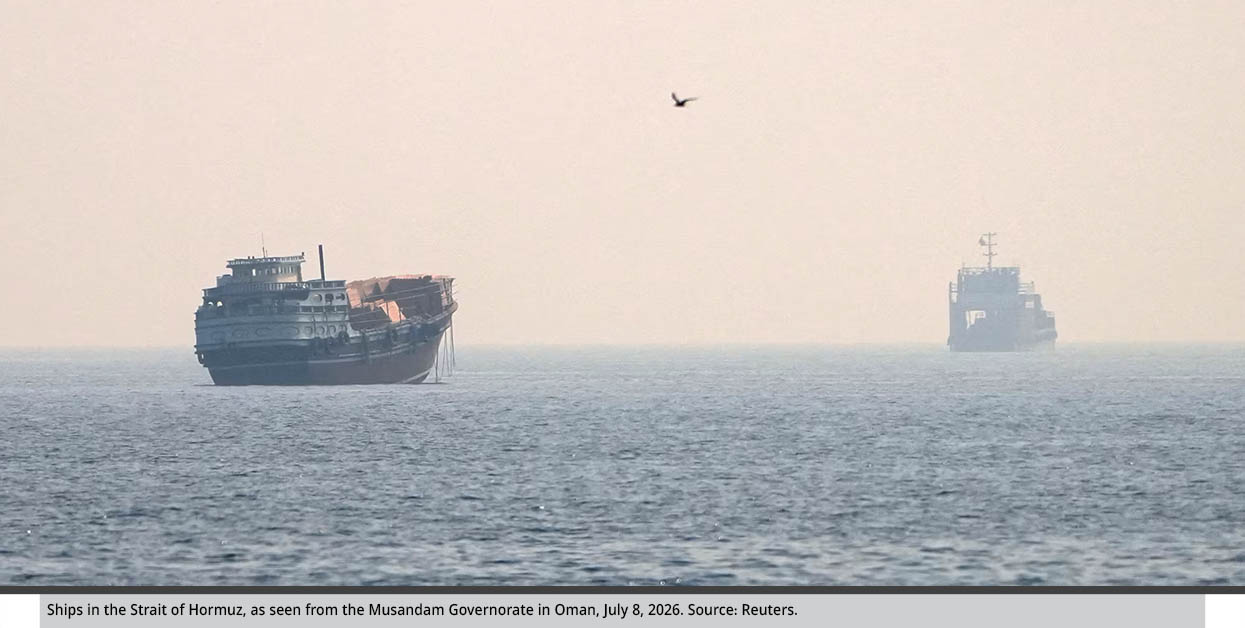
Iran is moving from the stage of threatening to close the Strait of Hormuz to a new stage in which it is attempting to impose a new fait accompli in the international strait. It is doing so by redefining the administration of the Strait through the establishment of regulatory and administrative mechanisms that impose permits, fees, and various inspection procedures on transiting vessels. In this context, a number of unlawful Iranian practices aimed at exercising effective control over the strait have emerged. On May 18, 2026, Iran announced the establishment of a new body to manage the strait, named the “Persian Gulf Strait Authority,” which is administratively affiliated with the naval forces of the Revolutionary Guard. On May 19, the authority defined the maritime area of the strait under its control as extending along a line from the strait’s eastern entrance at “Jabal Mubarak” in Iran to its western entrance near the edge of Qeshm Island.
In parallel, Iranian reports stated that Iran’s Ministry of Economic Affairs and Finance had established an electronic platform called “Hormuz Safe” to collect fees from transiting vessels in cryptocurrencies. Iran also rejected, on July 29, a proposal submitted by the Sultanate of Oman regarding the regional management of the strait, which closely resembles the regional cooperation mechanism for managing the Strait of Malacca and is based on Article 43 of the United Nations Convention on the Law of the Sea.
In fact, the Revolutionary Guard and its naval forces are the most prominent military, operational, and administrative actors responsible for the Strait of Hormuz file in Iran. The Revolutionary Guard has required vessels to coordinate directly with its naval units via the international maritime calling channel, VHF Channel 16, to receive transit instructions or permission to pass.
Notably, its statements have recently shifted threatening and employing force while asserting the closure of the strait, to using force to impose new navigation rules and regulatory mechanisms. It no longer announces that passage is prohibited, but rather that it is permitted in accordance with the system it determines. Through this discourse, the Revolutionary Guard seeks to affirm its effective control over the strait and establish it as a fait accompli. Perhaps the clearest example of this was when the Sultanate of Oman announced a temporary corridor for vessels through the strait. The Revolutionary Guard rejected this route and stated that vessels must use the routes announced by Iran and that transit through any other unauthorized routes would be considered illegal and dangerous.
From an analytical perspective, developments in the Strait of Hormuz are often viewed in terms of their regional and international repercussions, particularly their economic consequences, and their use by Iran to raise the costs of escalation for the United States. However, recent developments have revealed other dimensions of Iranian actions in the strait. The Revolutionary Guard is using the strait to consolidate its influence and control within Iran, as its control over the platforms regulating maritime transit, such as “Hormuz Safe” and the “Persian Gulf Strait Authority,” give it unprecedented dominance over key sectors of the Iranian economy and sources of hard and digital currency, while enabling it to exercise full operational control over one of the country’s most important assets.
The significance of this comes amid a widening gap between the Revolutionary Guard and the executive branch and the underlying competition between them: on the one hand, those seeking to strengthen the negotiating track and secure its outcomes, and on the other, the Revolutionary Guard, which seeks to use the war to expand its domestic role at the expense of the political establishment.
The Iranian regime is witnessing a shift from conflict between reformists and conservatives toward conflict between institutions, particularly between the Revolutionary Guard, which is closer to the line of former Supreme Leader Ali Khamenei, and the presidency and parliament, which are more inclined to warn of the repercussions of the war and the costs of the blockade for the regime and the state. This contradiction and conflict resurfaced in the case of a post by Foreign Minister Abbas Araghchi, who announced on X in April 2026 that the Strait of Hormuz would be opened, prompting a reaction from the Revolutionary Guard, which considered the matter to fall under its authority rather than that of the Foreign Ministry.
The Nature of the U.S. Response to Confront the Fait Accompli
Alongside long-term military operations, which have coincided with intermittent rounds of negotiations, the United States is dealing with the Revolutionary Guard’s measures in the Strait of Hormuz through a direct response aimed at undermining Iran’s ability to sustain the status quo in the strait. This is being pursued through three parallel and interconnected tracks: operational readiness, economic pressure, and a military response on the ground.
On July 29, 2026, Washington imposed sanctions on the newly established Iranian entities responsible for managing the strait, foremost among them “Hormuz Safe” and the “Persian Gulf Strait Authority,” while also targeting networks and companies belonging to Iran’s “shadow fleet” involved in smuggling oil to China, with the aim of tightening economic pressure on Iran. This comes as the U.S. military continues to impose a strict naval blockade, which it resumed on July 14, 2026, following the collapse of the temporary ceasefire and the renewed escalation.
In addition, the United States continues to carry out attacks and airstrikes against Iranian sources of threat to freedom of navigation in the strait. The attacks generally follow two operational patterns. The first involves conducting precision strikes against coastal radar sites, ground-based guidance stations, and Iranian air defense systems near the Strait of Hormuz.
The second involves intelligence, surveillance, and early-warning operations conducted by the U.S. fleet, monitoring stations, and maritime patrol aircraft such as the P-8 Poseidon, followed by an immediate response once any Iranian threat directed against commercial vessels is detected, whether through airstrikes or fire from U.S. warships to destroy maritime targets such as fast attack crafts (FAC) or to disrupt attempts to lay naval mines before they can be carried out.. This is accompanied by the provision of direct naval escorts to protect commercial vessels from Iranian attacks. The 11th and 31st Marine Expeditionary Units, which were deployed in March 2026, serve as the spearhead of emergency response operations for commercial vessels, as well as operations to raid and inspect Iranian vessels that breach the blockade.
In addition, U.S. Central Command has affirmed its readiness to conduct an intensive military campaign that could last one to two weeks, with the aim of crippling Iran’s missile capabilities and neutralizing threats to freedom of navigation in the strait. This has been accompanied by U.S. embassies in the region issuing simultaneous security alerts to their nationals on August 1, 2026, urging them to exercise heightened vigilance, prepare for possible travel disruptions, and consider leaving the region if tensions continue to escalate. However, this option remains linked to progress or deadlock in the negotiating track. On August 2, U.S. President Donald Trump announced the postponement of strikes against Iran after the broad outlines of an agreement had been reached… The agreement included the immediate and complete reopening of the Strait of Hormuz.
Shifting Pressure Away from Hormuz: The Expanding Scope of the Confrontation
Over time, Iran’s room for maneuver appears to be gradually narrowing, as the damage resulting from its conduct in the Strait of Hormuz is increasingly affecting its economic capabilities, oil resources, and political options, which are coming under maximum pressure from the tightening and expanding U.S. naval blockade. While Tehran lacks sufficient domestic instruments of power—whether economic tools capable of mitigating the effects of the blockade or military capabilities sufficient to break it—it is important to monitor potential Iranian measures intended to further complicate the situation for the United States. As the ability of its proxies to play a major supporting role has also declined considerably, particularly Lebanese Hezbollah, as well as the Iraqi factions facing domestic and regional pressures, there are growing indications of Iranian attempts to shift tensions to other vital regional maritime routes, foremost among them the Bab al-Mandab Strait.
In this context, the Houthis have once again entered the escalation. On July 20, 2026, the group announced the imposition of a complete naval blockade on vessels linked to Saudi Arabia after the latter prevented an Iranian aircraft belonging to Mahan Air from landing at Sanaa International Airport. This course follows the role played by the Houthis in the “Unification of the Arenas” strategy since November 2023, when they announced that they would prevent the passage of vessels linked to Israel through the Red Sea and the Bab al-Mandab Strait. With the group’s focus shifting from Israel to Saudi Arabia, the objective appears to be to sustain threats to freedom of navigation and exacerbate the risks surrounding strategic chokepoints. The Iranian strategy is not limited to utilizing the Strait of Hormuz and Bab al-Mandab; rather, it has come to rely on a broader concept based on expanding pressure on global trade networks by distributing threats across more than one maritime theater simultaneously.
Accordingly, if escalation continues and pressures intensify, Tehran is likely to seek to shift part of these pressures toward the Indian Ocean, such as by targeting Diego Garcia in the Chagos Archipelago, or targeting British bases in Cyprus, such as Akrotiri and Dhekelia. This is particularly relevant following the Revolutionary Guard’s warning on July 26, 2026, that Britain would become a “definite and legitimate target” if it supported the United States in any war with Tehran, after U.S. B-1 bombers took off from RAF Fairford in the United Kingdom on July 22, 2026, to strike targets in Iran. The possibility of the indirect spread of certain forms of threat to the Eastern Mediterranean also cannot be ruled out, whether through Iran’s regional proxies or through the use of drones to target energy-related infrastructure and ports.
Given the capabilities and tools available to Tehran and its network of regional allies, this scenario remains possible and is supported by previous precedents, including the Houthis’ and Iraqi armed factions’ joint claim that they targeted the Orot Rabin power station on the Mediterranean coast on July 10, 2024, as well as former Hezbollah Secretary-General Hassan Nasrallah’s warning in June 2024 that Cyprus would be targeted if it allowed Israel to use its military facilities.
Part of this strategy appears to be based on transforming the conflict into a network of threats across several maritime theaters and vital shipping routes, with the aim of dispersing international efforts and responses away from the Strait of Hormuz and preventing the conflict from being confined to the strait—a situation that would keep Iran in direct confrontation with the United States and perhaps, in the future, an international coalition. This strategy also gives Iran additional time to consolidate its unlawful arrangements in the strait.
Levels of Response and the Limits of Deterrence Against Iran
The Strait of Hormuz crisis has led to a multilateral international response that is no longer limited to the most prominent actor, the United States, but has also included European and regional initiatives and actions. On March 19, 2026, the leaders of Canada, France, Germany, Italy, Japan, the Netherlands, and the United Kingdom issued a joint statement expressing their “readiness to contribute to appropriate efforts to ensure freedom of navigation through the Strait”. At the time, 22 countries signed the statement.
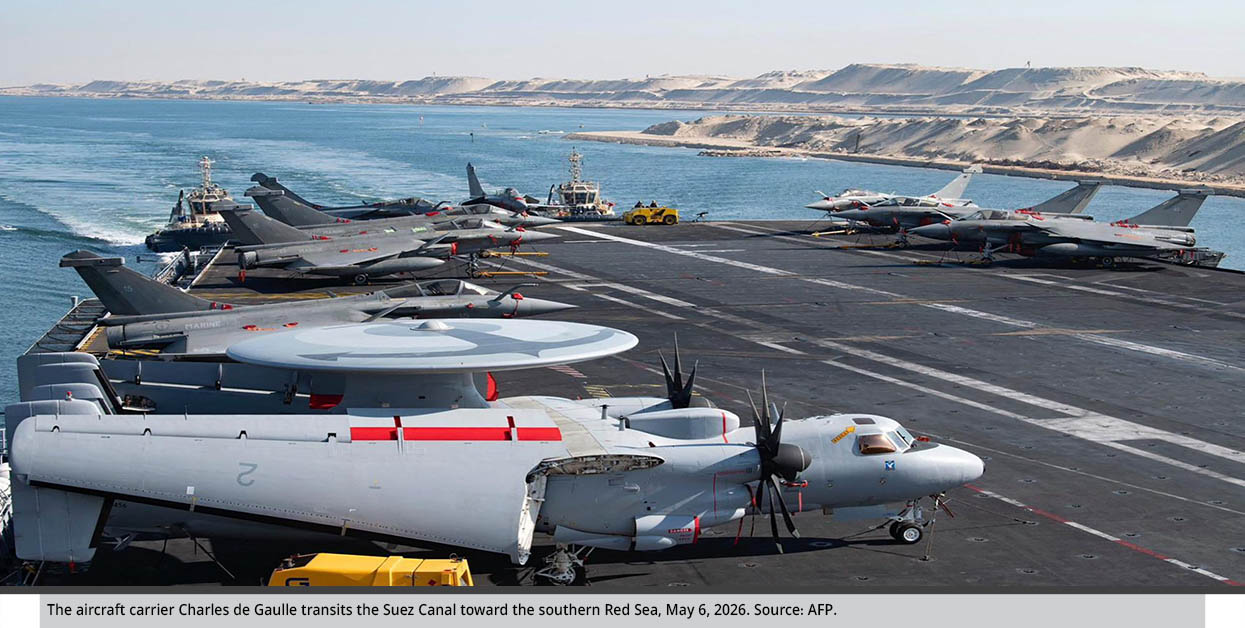
Since April 2026, the European military presence in the region has increased. Italy deployed around 400 air force personnel to countries in the region, supported by Eurofighter Typhoon fighter jets, air defense radars, and counter-drone systems, in addition to reports of the deployment of a SAMP/T air defense system. France also announced the deployment of major naval reinforcements comprising around 10 additional warships, including frigates and support vessels. In May 2026, Paris announced the deployment of the Charles de Gaulle carrier strike group to the Red Sea.
In June of the same year, Germany announced plans to deploy German naval units, including a minesweeper and a command and supply ship, to the Eastern Mediterranean and adjacent waters, in anticipation of a possible mandate from the parliament to secure the Strait of Hormuz and clear mines laid by Iran. On June 5, the European Union also amended and expanded the rules of engagement and mandated its naval operations, such as “Aspides” and “Atalanta,” to begin providing direct escort services and protection for commercial cargo vessels and oil tankers around the Strait of Hormuz and in the Arabian Sea.
Regionally, Saudi Arabia announced in early August 2026 a multinational defensive maritime coalition involving 13 countries to protect navigation in the Red Sea, Bab al-Mandab, and the Gulf of Aden.
In fact, there is a consensus regarding the nature of the military coalitions and reinforcements, particularly the regional and European ones, as they all focus on limiting military missions to a defensive role and avoiding being drawn into the military operations against Iran that were conducted by the United States and in which Israel has participated.
On the other hand, there are areas of convergence between U.S. objectives and the European approach. Washington seeks to dismantle Iran’s military capabilities, foremost among them the Iranian nuclear program and ballistic missile program, using a combination of direct military force and negotiations. By contrast, points of divergence with European capitals are evident in the nature of the operational approach. While Washington favors preemptive operations and direct strikes against infrastructure inside Iran, Europe remains committed to strict defensive limits.
These positions were reaffirmed during a meeting of the foreign ministers of the 27 European Union (EU) member states in Brussels on March 16, 2026, where the Europeans conveyed a joint message to the U.S. side that an attack on Iran was not “Europe’s war” and that EU countries would not assist Washington in securing the Strait of Hormuz, which Iran has placed under blockade. The actual capabilities of these initiatives and coalitions may appear limited when it comes to securing passage through the Strait of Hormuz or deterring Iranian attempts to introduce new navigational measures and arrangements. However, they could contribute to providing protective cover and direct defensive military escorts for commercial vessels transiting vital points extending from the Red Sea and the Bab al-Mandab Strait to the Gulf of Oman.
Nevertheless, the current crisis requires a new response that is not limited to protection and defense. It is also necessary to recognize the scale of the transformations taking place in strategic and operational decision-making within Iran, where the role of civilian institutions and diplomatic expertise accumulated over decades since before 2005 is declining in favor of the growing dominance of the Revolutionary Guard, particularly its third- and fourth-echelon commanders. Their calculations are dominated by operational and military considerations and the logic of imposing a fait accompli on the ground, without possessing the ability conduct a comprehensive, in-depth assessment of the war, its costs to the country’s strategic national assets, and its long-term repercussions for the economy and society. Against this backdrop, it is conceivable that Iran could resort to increasingly risky or poorly calculated moves, whether in the Strait of Hormuz or across the region, threatening to expand the scope of the confrontations and the number of participants involved, and potentially pushing defensive coalitions toward offensive action as a last-resort strategic option to break the cycle of attrition and prevent an irreversible slide toward the point of no return.
Finally, the success of the security arrangements currently taking shape, whether through multinational defensive coalitions or integrated regional and international initiatives, depends on the ability to achieve a delicate balance between firm deterrence on the ground and strategic caution that prevents a slide into a comprehensive regional confrontation that would generate further repercussions and disrupt global energy security and supply chains. Lasting stability at these strategic chokepoints will require a shift from short-term crisis management to a long-term containment strategy—one that combines the defensive protection of maritime routes with efforts to dismantle the capabilities and instruments Iran employs against commercial shipping.
*This study reflects the views of its author. STRATEGIECS Institute assumes no responsibility for any position or opinion expressed by the author regarding security, political, economic, social, or other issues. The views expressed herein do not necessarily reflect the position and/or views of the Institute.
Abdulmalik Hussein Amer/ Senior Researcher at STRATEGIECS Institute
Mohamed Nabil Al-Bandary/ Research Fellow at the Rabdan Security and Defence Institute in Abu Dhabi

AbdulMalik H. Amer And Mohammed Al-Bandari
Political Researchers