 العربية
The Strait of Hormuz and Iran’s Narrow Window for Maneuvering: Toward an Agreement or the Brink of Collapse
This paper seeks to answer several key questions: What does international law permit in the event of an Iranian closure of the Strait of Hormuz? How effective is the U.S. blockade of Iranian ports? And what are the likely scenarios for the evolution and dynamics of the Strait crisis?
by STRATEGIECS Team
- Release Date – May 24, 2026
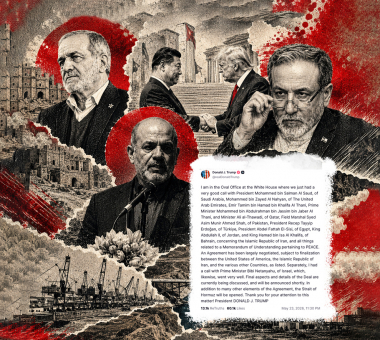
With the outbreak of the joint U.S.-Israeli military operations against Iran on 28 February 2026, the Strait of Hormuz entered a new phase of escalation. Iranian attacks on commercial vessels, legal pretexts, the laying of naval mines, and the practice of selective restrictions have turned the strait into a high-risk zone, accompanied by attempts to impose a new reality for managing the strait in a manner inconsistent with international law. Against the tactical and operational challenges posed by the geography of the strait in countering Iranian behavior, the U.S. counter-maritime blockade strategy has emerged as a strategic tool capable of forcing Iran to bear the consequences of its own behavior and transforming the Strait crisis into an internal struggle for survival. This paper seeks to answer several questions: What does international law permit in such a situation? How effective is the U.S. blockade of Iranian ports? And what are the likely scenarios for the evolution and dynamics of the Strait of Hormuz crisis?
The Strait of Hormuz: Iran’s Selective Restriction Policy
The dynamics of navigation through the strait have experienced two phases of decline. During the first days of the war, the reduction resulted from shipping companies reassessing maritime insurance costs after the strait became a high-risk area. Later, however, the decline became a direct response by shipping companies to Iran’s systematic attacks on commercial vessels and oil tankers.
With the outbreak of the war, maritime traffic through the Strait of Hormuz witnessed a sharp decline. According to data from the United Nations Conference on Trade and Development (UNCTAD), the downturn followed a steep trajectory beginning on 28 February 2026. The day before the war, approximately 141 vessels transited the strait; this number fell to 81 vessels the following day and then declined further on 1 and 2 March to 20 and 10 vessels, respectively. Following Iran’s announcement of the closure of the strait on 4 March, traffic dropped to unprecedented levels, with average transit rates falling to roughly five vessels per day during the initial days of the closure.
From a legal perspective, Iran’s operational conduct in the Strait of Hormuz does not constitute a “naval blockade.” Under Article 95 of the San Remo Manual on International Law Applicable to Armed Conflicts at Sea, the legal criterion for a blockade is “effectiveness,” which requires the complete prevention of the passage of any maritime or aerial units. Instead, Tehran is implementing a policy of “selective restriction” on maritime transit. On 25 March 2026, Iran informed the International Maritime Organization that vessels from “non-hostile” states could transit the strait after prior coordination. Initially, five countries were granted permission—China, Russia, India, Iraq, and Pakistan—before Malaysia, Thailand, and the Philippines were subsequently added to the list.
Through this approach, Iran seeks to achieve two objectives, each corresponding to a different time horizon:
Short-Term Objective: Strategic Deterrence
Iran seeks to use the strait as a means of protecting the regime from what it perceives as an existential threat arising from the U.S.-Israeli war. It aims to increase navigational risks, raise insurance costs, and create a severe shortage in oil supplies in particular. As a result of the closure, the world is currently facing an energy supply deficit estimated by the Federal Reserve Bank of Dallas at approximately 20 percent of global supplies, making this crisis the most consequential, in historical terms, compared with previous shocks. By comparison, supply shortages in the global market did not exceed 6 percent during the 1973 October War and the 1990 Gulf War, nor did they surpass 4 percent during the Iran-Iraq War in 1980. Consequently, the current geopolitical disruption is approximately three to five times greater than those disruptions.
Long-Term Objective: Imposing New Arrangements
Tehran aspires to redesign the security and legal arrangements that existed before the war by introducing the option of imposing sovereign transit fees on vessels passing through the strait. Despite the immediate financial returns and revenues that could potentially transform Iran into a major economic power, such a measure would also provide Tehran with significant geopolitical leverage, enabling it to mitigate the effects of decades-long U.S. sanctions on its economy. Moreover, if Iran were to succeed—an outcome that remains highly uncertain—in imposing this arrangement as a fait accompli, it would be capable of bringing about a dramatic shift in the balance of power in the Middle East and reshaping the legal and regulatory status of the strait in violation of the principles of freedom of navigation and the international law governing maritime passage.
The Gray Zone of Iran’s Legal Violations
Navigation through the Strait of Hormuz is governed by the rules of the United Nations Convention on the Law of the Sea (UNCLOS), which was adopted in 1982 after nine years of international negotiations and following the failure of three previous attempts to establish a comprehensive multilateral framework for navigation in the oceans: at The Hague in 1930, in Geneva in 1958, and again in 1960. The Convention is widely regarded as one of the most significant achievements of the international legal order. According to many observers, its importance rivals that of the United Nations Charter itself, as it has regulated the legal standards applicable across territorial waters, oceans, and the high seas since entering into force in 1994.
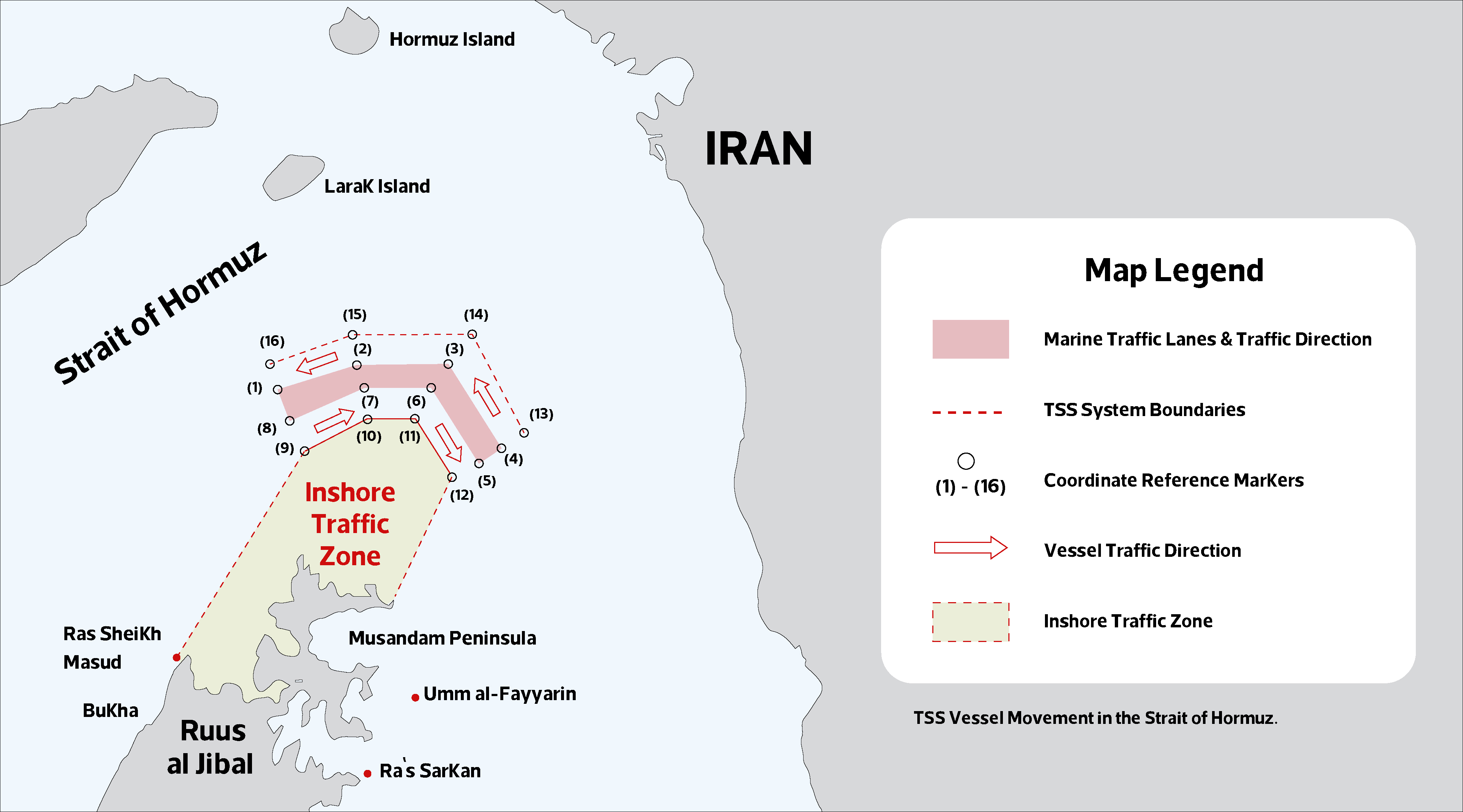
Under the Convention, the Strait of Hormuz qualifies as an “international strait.” On the one hand, it connects two major bodies of water and serves the interests of all nations, meaning that no single state may unilaterally control navigation through a global maritime passage. On the other hand, it links the exclusive economic zones of the Arabian Gulf with those of the Arabian Sea. In 1968, the International Maritime Organization adopted a Traffic Separation Scheme (TSS) for the Strait of Hormuz proposed jointly by Iran and the Sultanate of Oman.
Accordingly, Iranian attempts to impose a new legal reality, obstruct commercial shipping, target vessels, or detain them constitute not merely security threats but also serious and systematic violations of both customary and treaty-based international law. Iran justifies its position on the grounds that it has not ratified the United Nations Convention on the Law of the Sea (UNCLOS). It also maintains that the navigation regime applicable through the strait is “innocent passage” rather than “transit passage,” a longstanding point of contention between Iran and the international community. However, the law clearly indicates that vessels in the Strait of Hormuz are entitled to the right of transit passage.
Iran, however, argues that the strait overlaps with its territorial waters and that ships must pass through its coastal waters, thereby making “innocent passage,” in its view, the applicable legal regime.
The differences between the two navigation regimes—“transit passage” and “innocent passage”—extend far beyond procedural or technical distinctions. At their core, they constitute an axis for asserting geopolitical control and sovereignty between coastal states and the international community. The traditional regime of innocent passage grants coastal states broad discretionary authority, allowing them to subject maritime traffic to considerations of national security and sovereign interests. Foreign vessels are required to comply with the laws and regulations of the coastal state. The regime also imposes legal restrictions: overflight above straits is prohibited without prior authorization, submarines must navigate on the surface and display their national flags while transiting, and coastal states may intervene or temporarily suspend passage if they determine that a vessel is engaging in “non-innocent” passage.
In contrast, the law of the sea introduced the concept of transit passage as an innovative mechanism designed to balance the security concerns of coastal states with the principles of freedom of the high seas and international trade. Under this regime, ships enjoy freedom of navigation and aircraft enjoy freedom of overflight, provided that the passage is continuous, expeditious, and uninterrupted through the international strait. Coastal states are not permitted to suspend transit passage, while vessels may not stop or anchor except in cases of force majeure.
In practice, Iran’s actions reveal a contradiction in its exercise of sovereign rights. On the one hand, Iran relies on the Convention to justify extending its territorial waters to twelve nautical miles, a move that results in the overlap of Iranian and Omani waters at the narrowest point of the strait, which measures only twenty-one nautical miles across. Yet Iran does not comply with the legal condition attached to that maritime extension—namely, granting the right of transit passage. Even if one accepts Iran’s claim that the regime of innocent passage applies, its conduct would still violate the provisions of the 1958 Geneva Convention, to which Iran is a party, as that convention prohibits the suspension of innocent passage through international straits, whether by obstructing navigation or laying naval mines.
On the other hand, the overwhelming majority of the international community considers the regime of transit passage to have become part of customary international law and therefore binding on all states, regardless of whether they are parties to the Convention. States base this position on the landmark 1949 Corfu Channel judgment of the International Court of Justice, which established that navigation through international waterways and straits has absolute priority over the territorial and sovereign rights of coastal states, and that no state may close or temporarily obstruct an international strait under any pretext. Consequently, any attempt by Iran to impose domestic restrictions or levy unlawful transit fees on maritime traffic is inconsistent with the principles of freedom of trade and the law of the sea, which prohibits charging vessels merely for the exercise of the right of passage.
Furthermore, Oman’s commitment to the existing legal status of the strait and to the principle of freedom of transit navigation strips Iran of its regional cover and renders its actions unilateral and isolated, even from its closest neighbor in the strait. On 8 April 2026, the Sultanate of Oman rejected the imposition of transit fees on vessels. It reaffirmed its full commitment to the historical and legal status of the Strait of Hormuz as an international waterway open to navigation.
Challenges of the Military Response to Iran’s Closure of the Strait
In the face of Iran’s closure of the Strait of Hormuz, international options appear extremely limited, particularly because Iran is not physically sealing off the strait or imposing a formal legal blockade. While the United States and the broader international community have often responded to maritime aggression by forming naval coalitions or increasing military deployments to protect commercial shipping and conduct patrols in strategic waterways, the Middle East offers numerous examples of such measures.
For instance, the Combined Maritime Forces (CMF), established in 2022 and comprising more than forty states and several multinational task forces, was created to ensure security across the Indian Ocean, the Gulf of Oman, the Arabian Gulf, the Red Sea, and the Gulf of Aden. In 2023, the United States launched a military coalition known as “Prosperity Guardian” to deter and respond to Houthi attacks in the Red Sea. In 2024, the European Union launched “Operation Aspides” to escort commercial vessels and defend them against Houthi missiles and drones. Similarly, following Iran’s escalation in the Strait of Hormuz in 2019, during which Tehran targeted and seized several vessels and oil tankers, the United States and several Gulf and Western states launched Operation Sentinel.
Nevertheless, efforts to establish military coalitions or conduct unilateral operations to reopen the strait during and after the recent conflict face major obstacles. U.S. President Donald Trump previously called on states affected by the closure to contribute to reopening the strait. Britain and France also announced plans to form a coalition of forty countries to secure navigation through the waterway. Meanwhile, the United States launched “Operation Freedom Project” in early May 2026 to escort and protect commercial vessels transiting the strait, only for Trump to suspend the initiative several days later.
From a diplomatic standpoint, European states and other international powers have shown caution toward joining maritime defense coalitions that could make them direct participants in the war. As a result, many countries have preferred to remain on the sidelines despite the economic consequences of Iran’s actions in the Strait of Hormuz.
From a legal perspective, the escorting of commercial vessels by U.S. warships may produce unintended consequences. Iran has invoked Rule 67 of the San Remo Manual on International Law Applicable to Armed Conflicts at Sea, which provides that neutral merchant vessels sailing under the protection of enemy warships or military aircraft lose their neutral civilian status and may consequently become legitimate military targets. This has made certain aspects of the U.S. measures associated with “Project Spear” part of the problem itself. While the purpose of U.S. military escorts is to secure the vessels, Iran’s selective interpretation of international law treats such escorts as grounds for lifting the civilian cover from those vessels and classifying them as military objectives.
Despite relying on this legal justification, Iran loses its claim to legitimacy by being the party that initiated the violation through restricting navigation and targeting vessels. Consequently, Iran’s invocation of the principle of “neutralizing danger” without an actual danger existing could amount to a war crime. This is particularly the case because its attacks are conducted without clear mechanisms of distinction or prior warning and are intended to inflict economic harm rather than secure a concrete military advantage against a clear adversary. Moreover, Iran cannot create the danger through its own attacks on shipping and then invoke international law to justify striking vessels that seek to protect themselves from that danger. In addition, by targeting vessels linked to Gulf and Arab states, Iran has acted in violation of United Nations Security Council Resolution 2817 (2026), which affirmed that the Gulf states bordering the sea are not parties to the hostilities.
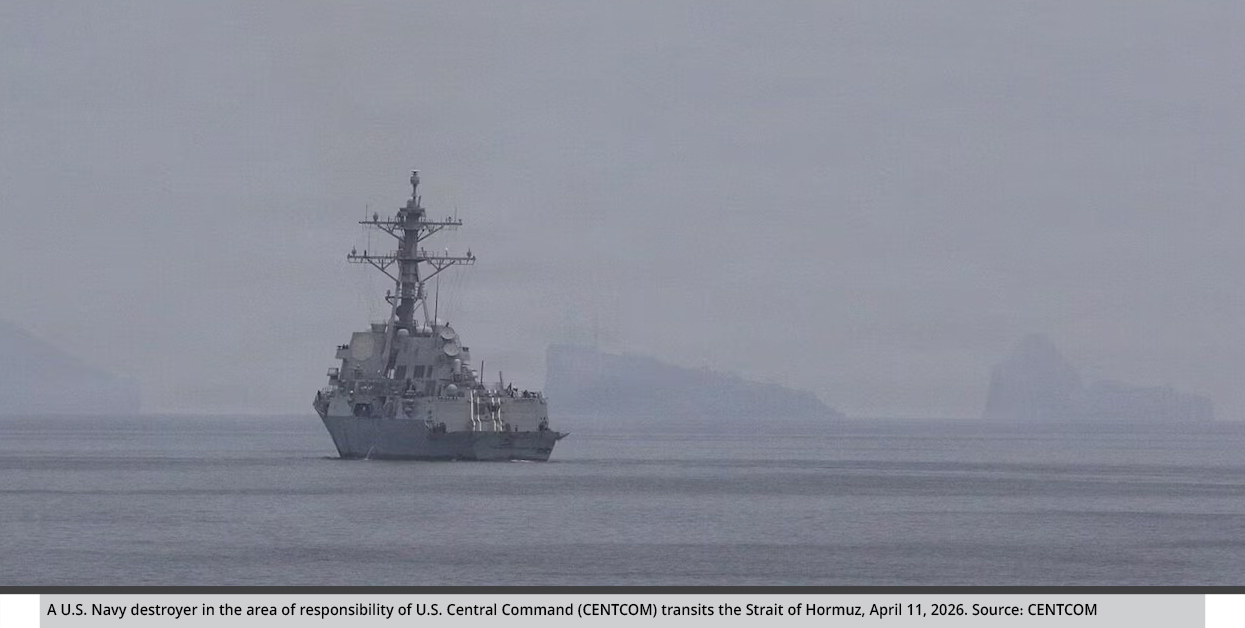
From a military perspective, however, neither coalitions nor military operations have succeeded in deterring Houthi attacks on shipping in the Gulf of Aden, the Red Sea, and the Indian Ocean. Consequently, they are unlikely to succeed against Iranian attacks, which present a far more complex challenge than confronting the Houthis in open waters.
The geographical characteristics of the Strait of Hormuz impose highly complex operational and tactical challenges on the U.S. Navy. The United States traditionally projects power in open waters through carrier strike groups and destroyers deployed across vast maritime spaces that provide freedom of maneuver, extensive operational reach, and the ability to detect and intercept threats from safe distances. The strait, by contrast, constitutes a narrow and shallow maritime environment classified as confined waters. The international shipping lanes within it are no more than two nautical miles wide in each direction, separated by a two-nautical-mile buffer zone. Under such geographical constraints, naval forces are deprived of their primary defensive advantages of distance and early warning.
Furthermore, Iran’s coastline along the Gulf of Oman and the Arabian Gulf extends for approximately 2,400 kilometers, creating significant operational challenges. This geographical expanse places both commercial vessels and military ships within the range of Iranian firepower. Iran’s mountainous and rugged terrain also enables it to deploy its land-to-sea missile systems effectively, while complicating counterstrike operations aimed at locating and targeting launch platforms.
In addition, Iran possesses the capability to disrupt maritime traffic through its inventory of medium- and long-range ballistic missiles, which can be launched from deep within its territory against fixed maritime targets. Tehran also relies heavily on asymmetric warfare tactics. Reports indicate that in April 2026, the Revolutionary Guard targeted two Indian-flagged cargo vessels attempting to transit the strait using fast attack boats. While defensive military escorts for tankers and cargo ships remain an effective means of countering threats posed by such boats, significant risks persist, particularly if Tehran resorts to large-scale coordinated attacks involving swarms of fast boats and drones. Such operations could overwhelm defensive systems and inflict damage on both military and commercial vessels alike.
The U.S. Blockade of Iranian Ports
Despite the challenges confronting the United States and the international community in responding militarily to Iranian maritime aggression, alternative options exist, particularly in the form of tightened economic sanctions designed to prevent Iran from using the strait as a geopolitical bargaining chip. In 2019, the United States expanded its sanctions against Iran to include the maritime shipping sector and the Islamic Republic of Iran Shipping Lines (IRISL) following a series of Iranian attacks on oil tankers in the Gulf of Oman and the Strait of Hormuz, including the attacks on the tankers Front Altair and Kokuka Courageous in the Gulf of Oman on 13 June, and the subsequent seizure of the British tanker Stena Impero by the Revolutionary Guard in the Strait of Hormuz in July of the same year.
Accordingly, the United States responded to Iran’s restrictions on navigation by announcing a blockade targeting Iranian ports, commercial vessels, and oil tankers associated with them that transit the strait in both directions. Given Iran’s heavy dependence on the strait for its oil exports, such a blockade affects not only the financial revenues that Tehran urgently requires amid sanctions and the consequences of war, but also the broader structure of its oil industry and logistics sector.
In most cases of supply disruptions, states respond by reducing oil production. Following the outbreak of the war, the Gulf states and Iraq rapidly implemented record production cuts amounting to approximately 6.7 million barrels per day, equivalent to one-third of their combined output.
In Iran’s case, however, the structural challenge posed by the blockade does not lie in maintaining production levels but rather in the near-total paralysis of its export capacity. The blockade has reportedly caused Iranian oil exports to decline by approximately 80 percent. Under these circumstances, reducing production levels does not constitute a practical solution for avoiding the scenario of a “forced shut-in of oil wells,” the indicators of which increasingly suggest an approaching reality.
During the first days of the blockade, Tehran sought to absorb its oil production by pumping crude into storage facilities and onshore tanks located on the strategically important Kharg Island. Once those facilities reached maximum storage capacity, according to reports by Bloomberg, the National Iranian Oil Company turned to “floating storage,” utilizing its fleet of oil tankers in the Arabian Sea. Data from the organization United Against Nuclear Iran indicate that the number of tankers being used as floating storage facilities has increased from twenty-nine before the blockade to forty-nine at present, carrying approximately forty-two million barrels of unsold crude oil.
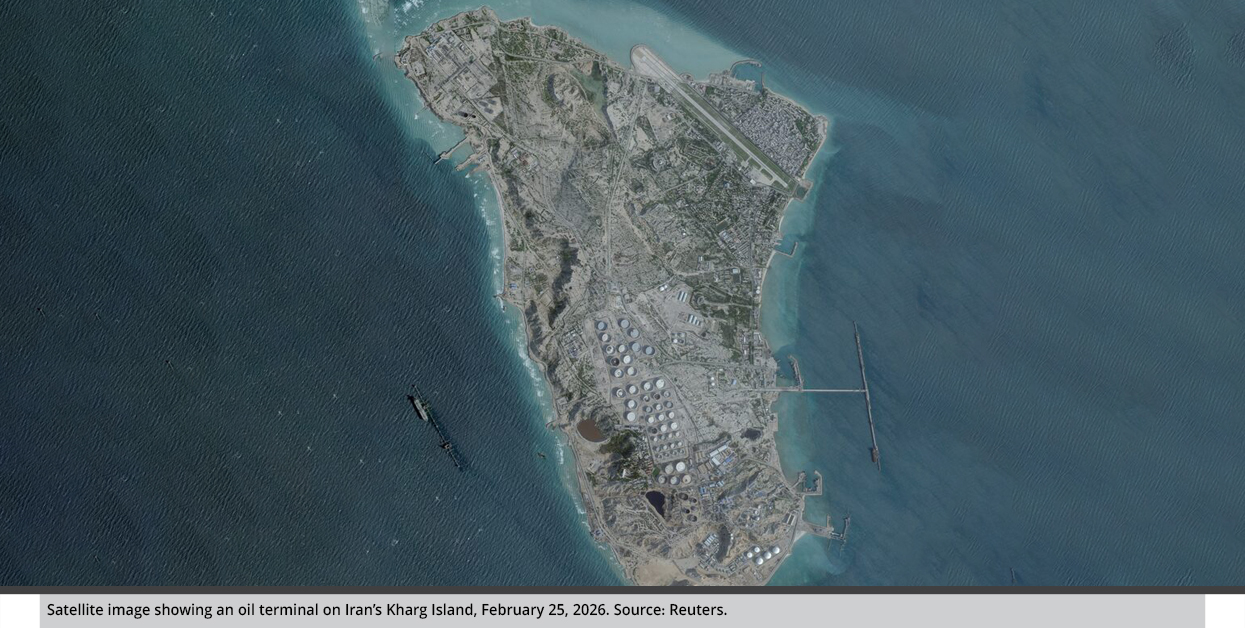
Although floating storage represents one method of crisis management, it entails significant financial costs and operational strain. Moreover, it is only a temporary solution whose effectiveness ends once tanker capacity is fully utilized. Oil storage itself is constrained by time, as prolonged stagnation in tankers or onshore storage facilities can lead to sludge accumulation and expose the crude to microbial and chemical corrosion due to the presence of water, salts, and sulfur compounds. These conditions encourage the growth of sulfate-reducing bacteria, which produce highly toxic hydrogen sulfide gas.
This challenge becomes even more severe if Iran is forced to confront a scenario of “forced shut-in.” Such a development could generate technical and operational consequences that inflict long-term, and potentially permanent, geological damage on Iranian oil fields. Additional risks include damage to equipment and reservoirs caused by the accumulation of solid deposits within pipelines, alterations in natural reservoir pressure, and groundwater intrusion into oil-bearing formations. Together, these factors could degrade critical infrastructure and require lengthy and costly restoration efforts.
Furthermore, shutting in oil wells in Iran would have other direct consequences. Associated natural gas production would also cease, as this gas is produced alongside crude oil and serves as the country’s primary source of fuel for electricity generation, industrial operations, and residential consumption.
Scenarios for the Strait Crisis Between the United States and Iran
The current Strait of Hormuz crisis is one of the most complex crises in the history of international navigation, involving an intricate interplay of legal, military, geographical, and logistical challenges. Its consequences extend far beyond the region, affecting the global economy and states around the world. Against this backdrop, four principal scenarios emerge:
First Scenario: Iranian Concessions and Acceptance of U.S. Demands
Iran’s room for maneuver in negotiations, as well as its continued intransigence, appears constrained by a very narrow time ceiling. From a strategic perspective, the blockade constitutes a measurable and quantifiable instrument of pressure. As Iran’s available time horizon narrows and it approaches forced shut-in, its capacity to withstand pressure diminishes, potentially encouraging it, under rational calculations, to adopt a more flexible stance toward U.S. demands. Supporting this scenario are increasing indications that an agreement may be near. On 23 May 2026, Trump announced that negotiations with Iran had concluded on most provisions of a prospective agreement, coinciding with signs that Iran’s oil industry had reached the brink of collapse.
Note!
This scenario is considered the most likley during the next 10 days
Second Scenario: Continued Constrained Attrition of Iran
A second possibility is the continuation of the status quo, whereby the United States maintains its blockade of Iranian ports while permitting limited and carefully calibrated oil exports. Such an approach would preserve the risk of forced shut-in while postponing its realization. In practice, the United States has allowed a restricted number of vessels carrying Iranian oil—particularly Chinese vessels—to transit the strait. Iran may also seek alternative methods to alleviate pressure on its oil sector, whether through overland exports to China or by employing tactics such as disabling tracking systems, falsifying vessel locations, or sailing under false flags.
Third Scenario: Iran Enters a State of “Forced Shut-In”
The United States may choose to intensify and fully enforce the blockade to accelerate Iran’s transition into a state of forced shut-in. Under such circumstances, the American blockade could serve as a practical alternative to renewed military conflict, or at least as a substitute for Trump’s threats to strike Iran’s energy and electricity infrastructure should Tehran continue tightening restrictions on traffic through the Strait of Hormuz.
Fourth Scenario: Renewed War and the Resumption of Military Operations
The possibility of renewed conflict remains. On the one hand, military operations would impose maximum pressure on Iran and could compel it to accept U.S. demands. On the other hand, such operations could involve large-scale efforts to establish operational control over the Strait of Hormuz and the islands adjacent to it, thereby denying Iran the geographical advantage that enables it to threaten freedom of navigation. These operations could be undertaken either as a unilateral U.S. military action or as part of a broader international coalition.

STRATEGIECS Team
Policy Analysis Team