 العربية
Pilot Zones in Southern Lebanon: A Test of the Field and Hezbollah’s Maneuvering Strategy
The pilot zones represent a test of the Lebanese state’s ability to assert its sovereignty, establish a state monopoly on arms, and strengthen the role of the Lebanese Armed Forces in southern Lebanon in return for the Israeli military’s withdrawal. At the same time, they test Hezbollah’s ability to adapt and maneuver within the new security equation. Against this backdrop, the project faces fundamental challenges in developing into sustainable field arrangements and a lasting security reality.
by STRATEGIECS Team
- Release Date – Aug 30, 2026
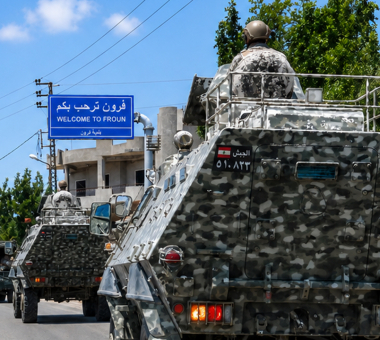
The concept of "pilot zones" has emerged the latest manifestation of efforts to place arms under state control in Lebanon, constituting an operational and military test of the country’s security and sovereignty arrangements. The trilateral framework (the Lebanese government, the United States, and Israel) seeks to impose a new equation aimed at neutralizing Hezbollah’s military infrastructure and stripping it of the initiative over decisions of war and peace. At the same time, the group finds itself facing an existential challenge that tests its ability to maneuver, adapt its logistical networks, and rely on flexible cells to reduce the impact of the "pilot zones." Accordingly, the next phase is likely to see Hezbollah attempt to establish a new equation of engagement aimed at undermining the legitimacy of the government and the ongoing negotiating process in Rome.
Context, Concept, and Implementation Mechanisms of the Pilot Zones
On June 29, 2026, the United States announced that it was sponsoring a framework agreement between Lebanon and Israel, which is essentially based on linking the Israeli withdrawal to the disarmament of armed groups, foremost among them Hezbollah, and the dismantling of its infrastructure. Under the agreement, the Lebanese Armed Forces would gradually assume full security responsibility in pilot zones of southern Lebanon, while Israeli forces would withdraw gradually upon the successful completion of disarmament operations in those pilot zones.
The agreement also affirms the state’s monopoly on arms and the government’s exclusive authority over decisions of war and peace, while Israel declares that it has no territorial claims or ambitions in Lebanon. It further provides for the establishment of a military coordination group with the participation of U.S. Central Command, as well as mechanisms to verify implementation. The agreement links progress in implementation to building the military capabilities of the Lebanese Armed Forces with U.S. support, alongside international assistance for Lebanon’s reconstruction, infrastructure rehabilitation, and economic support.
On the political side, the agreement provides for the establishment of working groups and direct channels of communication as a prelude to a comprehensive peace and security agreement, while also addressing other issues such as detainees and remains.
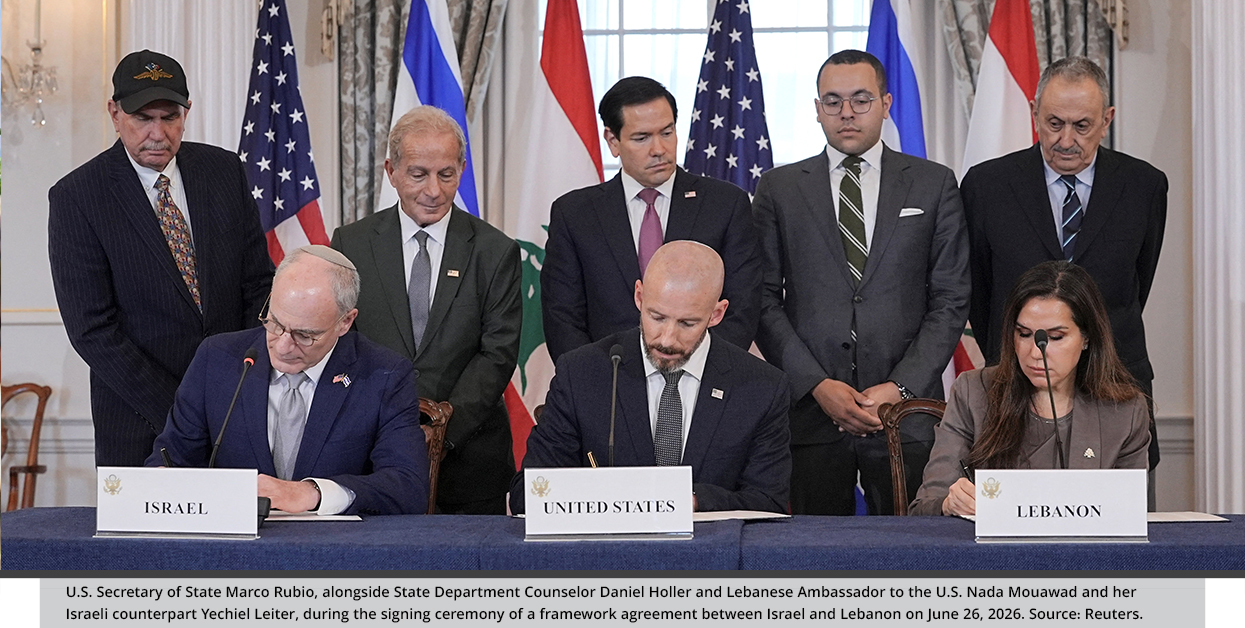
The framework agreement came in the context of the joint U.S.-Israeli war against Iran on February 28, 2026, and Hezbollah’s opening of a support front on March 2, marking a renewed escalation between Israel and Hezbollah since the ceasefire agreement of November 27, 2024. This prompted the Lebanese state, on March 2, to impose an immediate ban on all of Hezbollah’s security and military activities. Despite the first U.S.-Iranian truce entering into force on April 8, Israel rejected linking the Lebanese arena to the U.S.-Iranian negotiating track.
Accordingly, on April 14, Washington hosted direct negotiations between Lebanon and Israel based on a proposal put forward by Lebanese President Joseph Aoun on March 9, which separated the Lebanese and Iranian tracks and addressed the issues of Israeli withdrawal and restricting arms to the state. Israel accepted the proposal, and this process led to the framework agreement after five rounds of direct negotiations between Lebanon and Israel in Washington and Rome, which lasted from mid-April 2026 until late June of the same year.
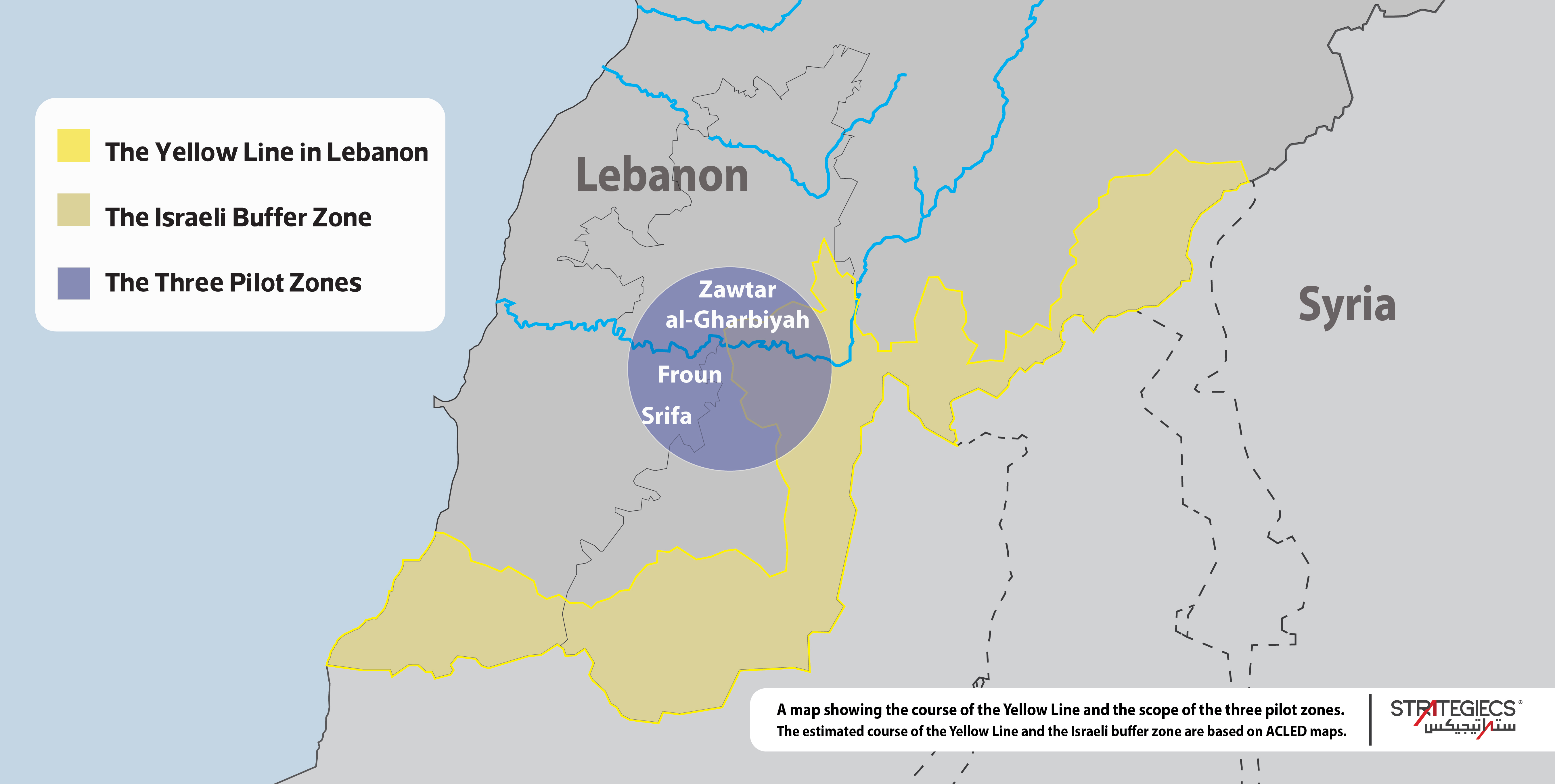
In fact, the map of the pilot zones shows that they form a single geographical zone, with the three towns located on both banks of the Litani River, despite not falling within a single administrative area. Zawtar al-Gharbiyah is located in the Nabatieh District, while Froun is in the Bint Jbeil District and Srifa in the Tyre District. It is notable that the three areas lie close to areas traditionally regarded as Hezbollah strongholds,, particularly Nabatieh and Bint Jbeil. While Froun and Srifa are located south of the Litani River, Zawtar al-Gharbiyah lies on its northern bank, indicating that the framework agreement has gone beyond Resolution 1701, whose implementation Hezbollah has long sought to confine to the area south of the Litani River.
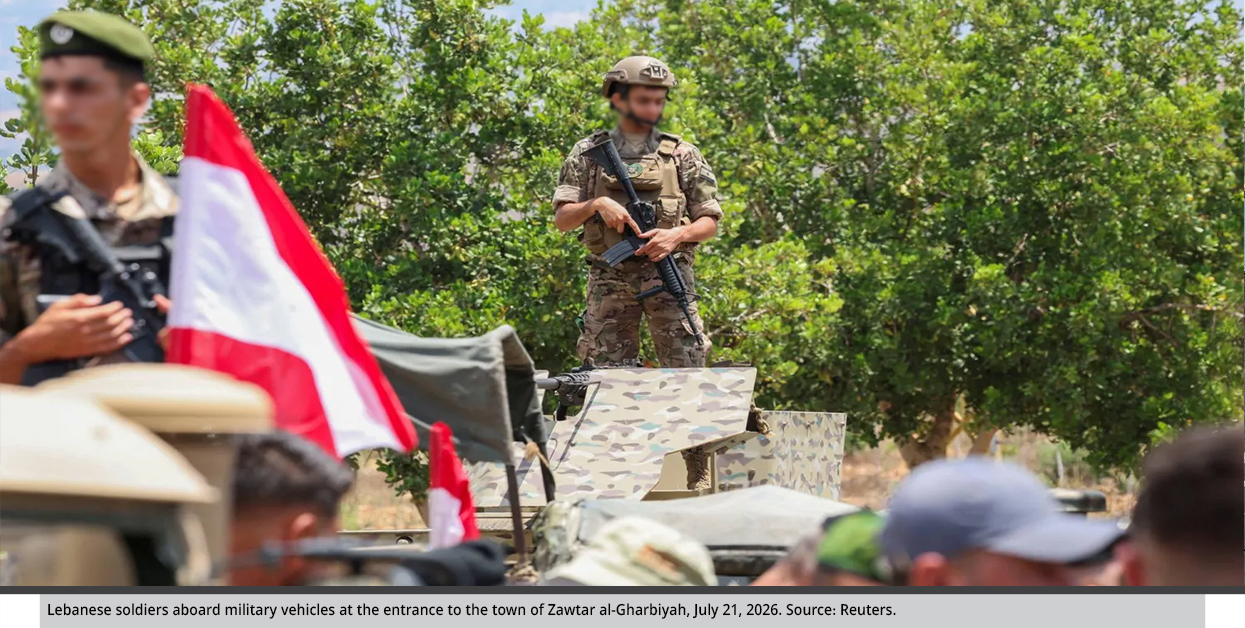
On the other hand, each of the three towns represents a different security situation. In the case of Zawtar al-Gharbiyah, the Israeli army withdrew to its outskirts after combing the town and handing it over to the Lebanese Armed Forces. Froun and Srifa, however, were already among the areas where the Lebanese Armed Forces had deployed during the first phase of its plan to place arms under state control, meaning that the operational process in the two towns differs from that applied in Zawtar al-Gharbiyah.
In addition, the eastern part of Zawtar falls within the Yellow Line established by the Israeli army to demarcate the buffer zone, which includes approximately 62 Lebanese villages and farms and extends from the town of Khiam in the east, through Taybeh and Bint Jbeil in the central sector, to Ras al-Bayada and the coast in the west. Froun and Srifa, by contrast, are located outside the Israeli buffer zone, according to an analysis by the Armed Conflict Location & Event Data Project (ACLED).
Accordingly, the pilot zones appear to face structural challenges, as they are not of equal significance. Zawtar tests the full equation in terms of the transfer of control from Israel to the Lebanese Armed Forces, while Froun and Srifa test, to a greater extent, the Lebanese Armed Forces’ ability to consolidate control and verify that the area is free of military infrastructure. On the other hand, the three towns differ in their operational contexts. The Israeli withdrawal from Zawtar al-Gharbiyah was preceded by extensive combing operations covering all facilities, particularly civilian ones, while the Lebanese Armed Forces face legal, political, and social challenges in searching private property.
Amid all this, the Lebanese Armed Forces face the challenge of how to deal with Hezbollah fighters in areas where they are deployed. Open-source data indicate that Hezbollah fighters and members continue to operate and move within the three towns. This means that the pilot zones are not active combat zones in which the Lebanese army can target or arrest any armed individuals, unlike Israel.
The scale of these challenges was perhaps most evident when Israel informed Washington in late August 2026 that the "pilot zones" project had failed, followed by the Israeli army’s renewed incursion toward the town of Zawtar al-Gharbiyah on August 30. This development reflects the fragility of the security and field arrangements underpinning this approach. Nevertheless, the United States continues to support the project as the most realistic path toward establishing stability in southern Lebanon. In this context, the message—and Israel’s decision to convey it to Washington through a security channel—can be interpreted as a warning rather than a definitive declaration that the project has failed or reached an impasse. Israel seemingly seeks to share its assessment with the American mediator to reopen negotiations over the mechanisms for implementing the understandings and the guarantees for their enforcement on the ground, ensuring that they are better suited to the nature of Hezbollah’s military structure. These issues are expected to be addressed during the eighth round of the Rome negotiations, scheduled for early September.
Challenges in Monitoring and Detecting Hezbollah’s Military Infrastructure
Ensuring that the pilot zones are free of Hezbollah’s infrastructure does not necessarily guarantee that the group will not redeploy in those areas or that it does not possess undetected military infrastructure there. Following the ceasefire agreement of November 27, 2024, which stipulated that the area between the Blue Line and the Litani River be free of unauthorized weapons and military infrastructure not belonging to UNIFIL, the Lebanese Armed Forces moved quickly to deploy in areas of southern Lebanon, particularly in villages and towns traditionally associated with Hezbollah. During this process, the army deployed around 10,000 troops, established 200 military sites and 29 permanent checkpoints, and, by June 2025, Lebanese Prime Minister Nawaf Salam announced that the army had dismantled more than 500 military sites and facilities and weapons depots south of the Litani River.
In August 2025, the Lebanese government approved a five-phase army plan to restrict arms to the state, beginning south of the Litani River and expanding northward until arms were restricted to the state nationwide. In November of the same year, the army presented its operational plan, known as "Homeland Shield," and on January 8, 2026, announced that the objectives of the first phase had been achieved.
Nevertheless, when the joint U.S.-Israeli war against Iran broke out on February 28, 2026, Hezbollah quickly returned to fighting in southern Lebanon on March 2. Although the group relied on missiles, drones, and loitering munitions, the axes of fighting between the two sides encompassed wide areas of southern Lebanon, particularly in front-line villages such as Aita al-Shaab, Adaisseh, and Taybeh. This prompted the Israeli army to expand the buffer zone from five kilometers to approximately 10 kilometers inside Lebanese territory.
Accordingly, attempts to geographically restrict arms did not, in practice, achieve the state’s monopoly over the decision of war, nor did they deter Hezbollah from redeploying despite the extensive military presence of the Lebanese Armed Forces and UNIFIL, as well as the Israeli military deployment in place prior to March 2026 in the buffer zone extending up to five kilometers into Lebanese territory, in addition to continuous surveillance and monitoring operations and ongoing human, electronic, and technical intelligence activities in the area.
In fact, the Hezbollah’s military structure complicates efforts by the parties to detect and neutralize it, as the absence of indicators of its military activity does not necessarily mean the absence of its military capabilities. Over decades, the group has worked to conceal its infrastructure and make it more difficult to detect by relying on a network of tunnels and underground facilities, often hidden beneath agricultural land or civilian infrastructure. Between February and June 2025, UNIFIL documented the discovery of 67 tunnels and underground facilities, while noting that some tunnels required technical expertise to enter and inspect.
On the other hand, the group relies on small storage sites rather than large weapons depots, making the detection of its entire storage network a complex matter. In the first three months following the November 2024 ceasefire, UNIFIL announced the discovery of more than 160 weapons caches. Detecting and locating mobile rocket launchers is even more complex, as they are constantly relocated. Despite the Lebanese Armed Forces announcing the seizure of 579 rocket launchers between December 2024 and February 2026, the group remained capable of launching rockets toward Israel during the subsequent escalation beginning in March 2026.
Perhaps more importantly, weapons seizure operations rely primarily on intelligence, as it is practically impossible to search an area exceeding 850 square kilometers, which is the area covered by the first phase of the aforementioned army plan. In parallel, Iran continues its attempts to supply Hezbollah with weapons, with recurring security reports revealing attempts to smuggle weapons to Hezbollah from Iraqi territory into Lebanon via Syria.
Hezbollah’s Room for Maneuver Amid the Existing Arrangements
The pilot zones do not appear capable of resolving the issue of arms, as Hezbollah continues to refuse to surrender its weapons, while Israel links its withdrawal to achieving this objective. The main variable in the pilot zones equation is that Hezbollah is now excluded from the negotiating and operational tracks of the existing arrangements. While the group was part of the November 2024 agreement and believed that the process of restricting arms would be negotiated between it and the state, its current ability to influence the process appears limited to the military dimension and its attempts to undermine the government’s legitimacy and its ability to operate within an inclusive national framework.
While the pilot zones track continues to expand on the ground, Hezbollah continues to carry out operations. On August 15, the Israeli army said that three Israeli soldiers were wounded in a Hezbollah attack in the Ali al-Taher area of southern Lebanon. Israel responded with its most extensive attack since the framework agreement was signed, including a strike on a central Hezbollah headquarters in the Ansar area of southern Lebanon, which resulted in the killing of Ali Samir, a commander in the Radwan Force.
In fact, by sustaining the escalation, Hezbollah no longer aims to change the situation on the ground between itself and Israel in the south or to restore deterrence according to the equation that previously governed the rules of engagement between them. Rather, it seeks to establish a domestic equation based on derailing the diplomatic process pursued by the Lebanese government and Israel under U.S. sponsorship.
Previously, the Israeli deployment and escalation, alongside the difficult humanitarian conditions faced by residents of southern villages and towns, were linked to the adverse consequences of the military confrontations between Hezbollah and Israel and the group’s participation in the "support fronts." Following decisive Israeli strikes against the group’s leadership structure, Hezbollah agreed to the November 2024 agreement, which granted Israel operational freedom in Lebanon and did not address the issue of the border buffer zone. Moreover, Hezbollah’s escalation after March 2026 led to an expansion of the Israeli military deployment, the destruction of part of the civilian and vital infrastructure in the south, and rising humanitarian and social costs.
Accordingly, Hezbollah is attempting to challenge the narrative adopted by the government and the group’s opponents regarding the outcomes of the war by demonstrating that the parallel diplomatic process does not provide Lebanon with greater gains in terms of sovereignty than those its weapons failed to achieve. Hezbollah Secretary-General Naim Qassem expressed this position on August 4, 2026, claiming that the direct negotiations had brought Lebanon nothing but "gratuitous concessions" on the ground. This prompted Prime Minister Nawaf Salam to respond: "The greatest service rendered to Israel came from those who unilaterally dragged Lebanon into futile support wars, giving it pretexts to attack our country, violate its sovereignty, destroy its cities and villages, kill its people and displace hundreds of thousands."
On the other hand, Hezbollah links discussions over the future of its weapons to the Israeli withdrawal from Lebanese territory. This stands in contrast to the negotiating track, which links a gradual Israeli withdrawal to the deployment of the Lebanese Armed Forces and the disarmament of Hezbollah. In doing so, the group seeks to shift the focus of the conflict from its setbacks on the ground to its ability to confront the government’s rhetoric and measures.
This approach appears connected to a broader pattern among the parties of the "Unifications of the Arenas," recurring in different forms across other regional issues. Hamas links the surrender of its weapons to an Israeli withdrawal from the Gaza Strip, while Israel insists on linking a gradual withdrawal from the Yellow Line to the border to progress in the disarmament process. Meanwhile, Iraqi factions link the weapons issue to the future of the U.S. military presence. In all three cases, the same problem emerges: each party seeks to make the other side’s fulfillment of its commitment a precondition for fulfilling its own, turning the issue into a negotiating and operational impasse capable of prolonging the conflict.
Finally, the success of the pilot zones depends on achieving stability on the ground where they are being implemented. Hezbollah, by contrast, seeks to create a complex and unpredictable operational reality by sustaining controlled escalation, which complicates the negotiating process while placing the Lebanese government under pressure to demonstrate tangible results. Therefore, the success of the trilateral negotiating track and the measures arising from it depends on the speed of implementation, ensuring its sustainability, and understanding how Hezbollah is attempting to influence it.
Otherwise, the project’s faltering may become the agreement’s defining feature, and the three towns—particularly Zawtar al-Gharbiyah—may become a gray zone in which the Lebanese Armed Forces are deployed while the Israeli army conducts incursions. This could place both sides at risk of an uncalculated engagement or expose the Lebanese Armed Forces to domestic scrutiny, particularly from residents of southern Lebanon, as it seeks to extend its control there.

STRATEGIECS Team
Policy Analysis Team