 العربية

Eisenkot’s Mandate: Majority Calculations and the Limits of Political Consensus
The assessment examines Gadi Eisenkot’s mandate to form the Israeli government following elections that failed to produce a clear parliamentary majority, and the complexities he faces in obtaining a parliamentary majority to secure a vote of confidence for his government, amid a political landscape in which ideologies and positions diverge among the parties within his camp, and in light of the limited understandings between him and forces outside his camp.
by STRATEGIECS Team
- Release Date – Nov 11, 2026

Gadi Eisenkot was tasked with forming the next government amid an inconclusive parliamentary composition, with neither of the two competing camps able to secure a parliamentary majority that would allow for the formation of a stable government. Eisenkot faces a complex coalition equation, given the ideological and fundamental disagreements within the "Bloc of Change" over many key issues, and his efforts to reconcile these differences and attract parties from outside his camp. In this context, the formation of the next government appears to face several options and scenarios, revolving around Eisenkot's chances of building a majority and, subsequently, his options for forming a stable government. This is alongside the possibility of Netanyahu managing to change the facts on the ground and obstruct the formation or stability of the government, and remaining as a caretaker government before heading toward early elections.
Political Context and the Course of Consultations
Israeli President Isaac Herzog tasked Gadi Eisenkot, leader of the Yashar Party and former Chief of Staff of the Israeli army, with forming the new Israeli government on November 8, 2026. He has 28 days to form the government, a deadline that initially expires on December 6. He may request an extension from the president for an additional period of up to 14 days, expiring on December 20. This step represents a post-election political shift following the parliamentary elections held on October 27, which failed to produce a parliamentary majority for either of the two competing camps, leaving Prime Minister Benjamin Netanyahu facing the possibility of losing power after years of leading the government. Hence, Eisenkot's mandate is significant for the "Bloc of Change" in strengthening its chances of unseating Netanyahu, despite Likud being the largest party in the Knesset. According to Article 7 of the Basic Law: The Government, the president tasks a Knesset member whom he considers most capable of forming a government and securing the Knesset's confidence, without requiring the candidate to be the leader of the largest party or the head of the largest parliamentary bloc.
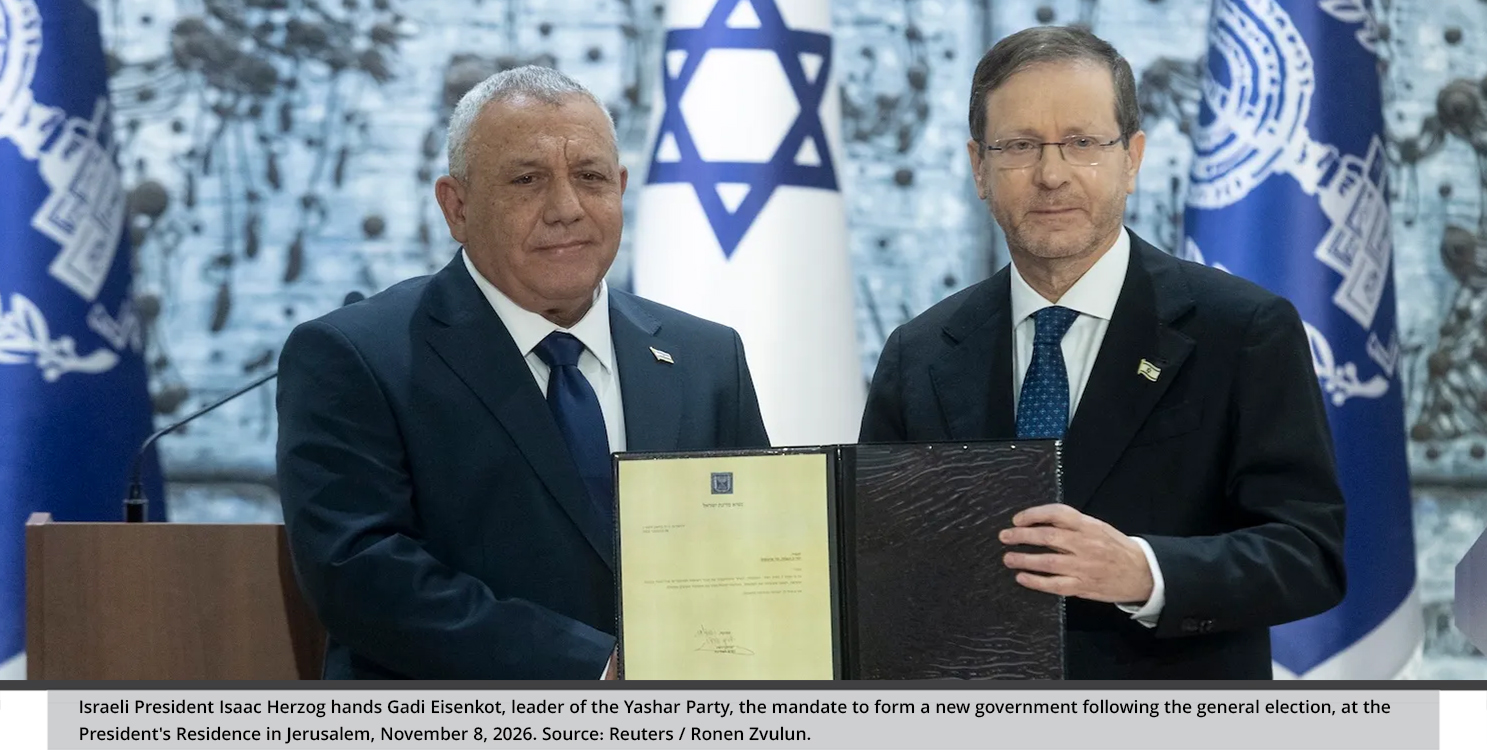
In fact, the elections produced a complex parliamentary landscape, with Netanyahu's camp securing 53 seats, compared to 48 seats for the “Bloc of Change” led by Eisenkot. Thus, neither camp obtained the required majority to ensure the formation of a government, set at 61 out of the Knesset's 120 seats. However, the rise of the Arab parties, which secured 19 seats and supported Eisenkot, gave him the opportunity to form the next government. He received recommendations from blocs representing 67 members, compared to 46 members who recommended Netanyahu, despite the failure to achieve a decisive victory over Netanyahu's camp, particularly as the seven-seat United Torah Judaism bloc refrained from recommending any candidate.
Immediately after being tasked with forming the government, Eisenkot announced that he would work to establish a "national emergency government," stressing that the task requires unconventional political moves and concessions from various parties. Nevertheless, he set out four political principles as conditions for parties and members of the Knesset to join the government he seeks to form. These are: the recognition of Israel as a Jewish, democratic, liberal, and equal state; adhering to the values of the Israeli Declaration of Independence; imposing mandatory service on everyone, whether military, national, or civilian service; and, finally, the recognition of Hamas as a terrorist organization and committing to dismantling its military and governing capabilities in the Gaza Strip.
Through these principles, Eisenkot establishes a mechanism for testing the parties seeking to join his coalition. The first and second principles set the ideological and political framework for his anticipated government, while the third targets the Haredi parties that reject subjecting religious seminary students to the mandatory conscription law. The fourth principle, meanwhile, puts the Arab parties to an additional political test, given that some of them have reservations about describing Hamas as a terrorist organization. This prompted Mansour Abbas, head of the United Arab List, on November 10 to agree to classify Hamas as a terrorist organization. More importantly, Eisenkot may be seeking to attract members of the Knesset from Likud and other parties into his coalition, rather than limiting his efforts to the four parties that make up the “Bloc of Change”.
The "Bloc of Change": Agreement on Change and Differences over Governance
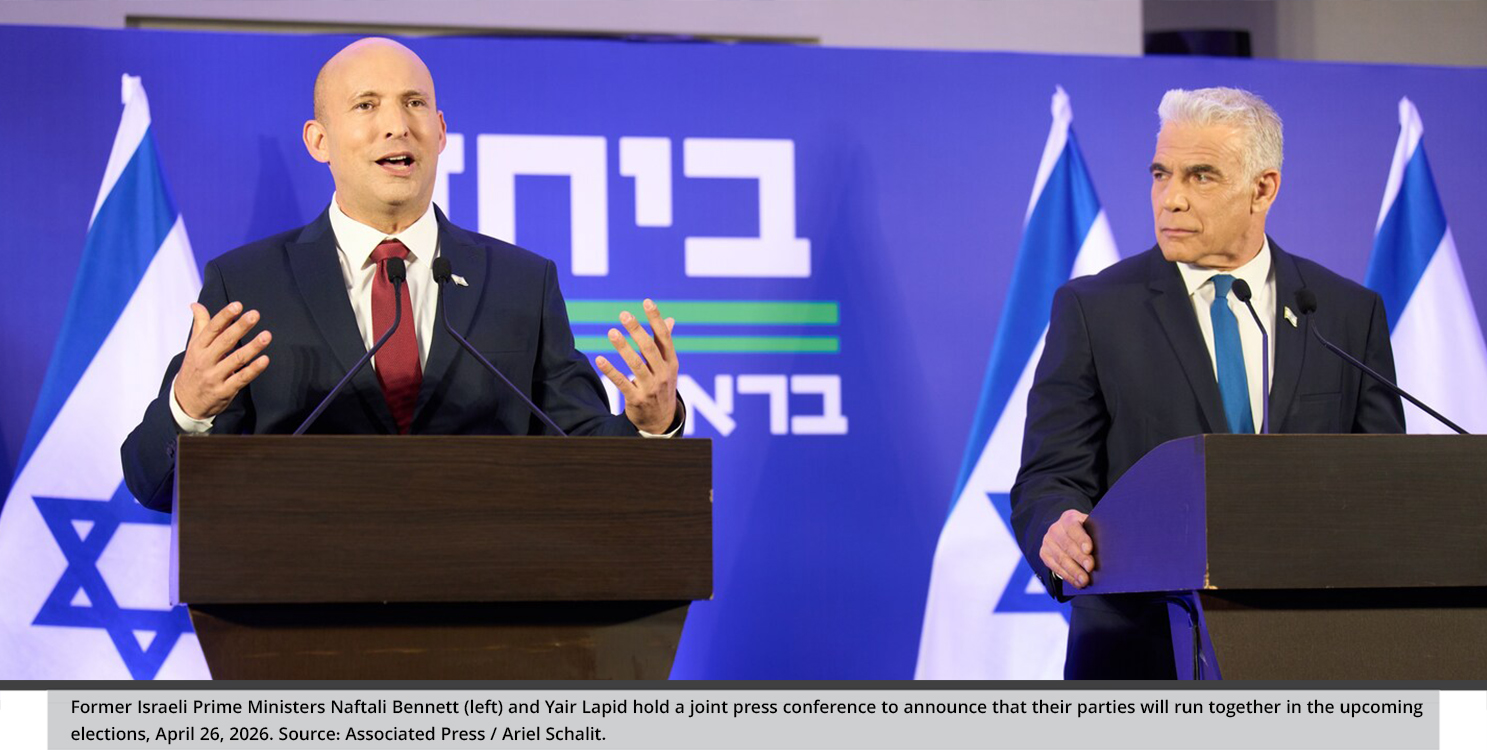
The "Change Camp" comprises four Israeli parties that reached electoral understandings around a single objective: ending Benjamin Netanyahu's rule and forming an alternative government led by Eisenkot. These parties are Yashar, the Together alliance led by Naftali Bennett and Yair Lapid, the Democrats party led by Yair Golan, and Yisrael Beiteinu led by Avigdor Lieberman. They secured 21, 12, 8, and 7 seats, respectively.
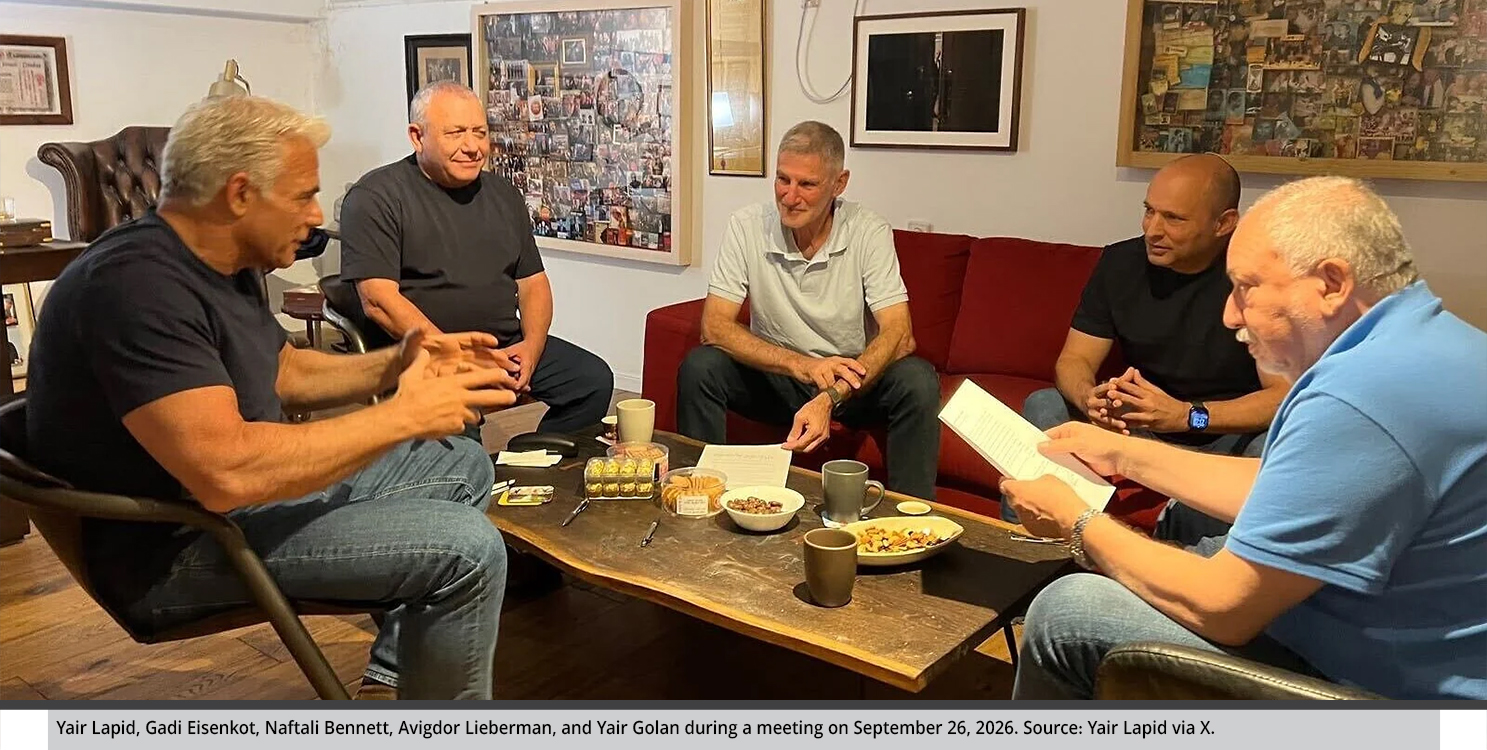
Nevertheless, this camp does not represent a homogeneous ideological bloc, as it encompasses a broad ideological spectrum ranging from centrist, right-wing, left-wing, and secular currents. However, they agree on a number of key issues, foremost among them ending the Netanyahu era and the need to form an alternative government, in addition to their varying degrees of opposition to the "Judicial Reform" project. They also agree on the need to establish an official commission of inquiry into the failures of October 7, 2023, as well as agreeing in principle on opposing the exemption of Haredim from military service.
By contrast, these parties differ on other key issues, foremost among them forming an alliance with the two Arab lists, the Joint List and the United Arab List. Naftali Bennett and Lieberman represent the current most opposed and reserved toward a political alliance with Arab parties, while Lapid has experience in Cross-ideological coalitions, including his participation in the Israeli government in 2021, which included the United Arab List. This suggests that he may be open to Arab support, particularly in the election of the Knesset Speaker, without accepting a government that relies on the same votes.
In addition, the camp does not have a unified vision or approach toward the Palestinian issue. While Eisenkot rejects the establishment of a Palestinian state in its current form, Bennett and Lieberman appear more hardline in rejecting the establishment of a Palestinian state in principle. Lapid, meanwhile, has previously supported a two-state solution under security conditions, while Golan calls for a two-state solution, halting settlement expansion, and rejecting annexation in the West Bank. Although the four parties agree on conscripting the Haredim, they differ over the nature of the civil state and its relationship with religious institutions, as well as the scope of reforms concerning personal status, marriage, and public transportation on Saturdays.
Accordingly, Eisenkot faces an additional challenge even if he succeeds in securing a parliamentary majority, as ideological differences among the four parties could obstruct the decision-making process, particularly on issues over which their positions diverge. Recognizing the scale of these complexities, Eisenkot appears to be adopting an unconventional political discourse focused on calling for the formation of a national government and putting forward general principles that provide common ground for consensus, thereby facilitating understandings with his partners within the “Bloc of Change” first, while opening the door to attracting neutral parties or some forces belonging to Netanyahu's camp second.
Coalition Calculations and the Safety Net in the Knesset
The bloc of Change, with its 48 members, needs an additional 13 seats to reach an absolute majority of 61 members. To achieve this, Eisenkot has two options. The first is to form an alliance with the Shas party, which holds 6 seats, and United Torah Judaism, which holds 7 seats. Under this option, he would need to secure their agreement to join his government, resolve disagreements with them over conscription and religious funding, and work to convince his partners within the bloc of these understandings, in addition to his electoral base, which voted for him based on his declared positions, particularly regarding mandatory conscription.
The second option is to form a "minority government" in which the parties of the bloc of change participate, but which receives the votes of the Arab parties, with their 19 seats, while simultaneously benefiting from the Haredim's neutrality and their refusal to support either side. This would facilitate the formation of the government but would not guarantee its subsequent stability, as the arrangements would be more complicated, particularly with regard to passing the budget and other key legislation.
In general, Eisenkot faces three levels of political and parliamentary understandings. The first is a procedural understanding concerning changes to the Knesset speakership and the chairmanship of parliamentary committees; the second is an understanding on granting confidence to the new government and forming the cabinet; the third is a sustainable political understanding that ensures coalition cohesion and prevents the government from being brought down. The first level can be achieved without reaching an understanding on the second level, just as Eisenkot's success in forming his government does not guarantee its continued survival under the third level. Meanwhile, despite losing the initiative in the government-formation process, Netanyahu remains capable of exploiting the contradictions among his opponents within the Knesset and in government formation negotiations, potentially obstructing Eisenkot's efforts or limiting his government's ability to remain in office.
Accordingly, the Knesset speakership represents the first test facing Eisenkot and the clearest entry point for translating his mandate into institutional influence. If his camp succeeds in electing a new Knesset Speaker with the support of the Arab parties, this step will have three political and institutional implications: ending the tenure of Amir Ohana, who is close to Netanyahu, thereby changing the balance between the outgoing government and the new Knesset; demonstrating Eisenkot's camp's ability to organize a joint vote with the Arab parties without requiring an agreement on forming a government; and turning the Knesset speakership into an influential position in managing the transitional period, including the procedures related to presenting the new government to parliament once its formation is complete.
In this context, the leaders of the camp's parties reached a series of understandings regarding candidates for positions in the Knesset and its key committees. These include nominating former minister Matan Kahana of the Yashar Party for the position of Knesset Speaker, appointing Lieberman as chairman of the Foreign Affairs and Defense Committee, having Roy Folkman of the Yashar Party head the Arrangements Committee, and appointing Liran Avisar of the Together Party as chair of the Finance Committee. Preliminary agreements were also reached on the formation of special committees.
This demonstrates the Yashar Party's control over the Knesset speakership and the Arrangements Committee, which is expected to be chaired by the party's parliamentary bloc leader. The significance of this lies in Eisenkot's ability to build early influence over the Knesset's agenda, the formation of its committees, and the distribution of their responsibilities. Control over the Finance, Foreign Affairs, and Defense Committees also represents the acquisition of proactive influence over Netanyahu's incumbent government, particularly under a scenario in which it remains in place as a caretaker government for a longer period. This would create a political duality: Netanyahu's government continues to exercise executive authority, while a different parliamentary majority manages some of the legislative and oversight tools.
In this case, the role of the Arab parties emerges as a decisive factor in procedural votes. On the one hand, convening a session to vote on replacing the Knesset Speaker requires the support of an absolute majority of 61 members. To elect a new candidate, the candidate who receives the highest number of votes from those present is elected if there is more than one candidate. In this context, the Arab parties support changing the Knesset Speaker, considering it a key step toward weakening Netanyahu's camp.
Nevertheless, the Arab parties' agreement to replace the Knesset Speaker does not necessarily mean supporting the next government or the legislation associated with it, such as the budget, or agreeing with its policies. Relying on the Arab parties to elect the Speaker is not politically equivalent to relying on them to grant confidence to the government. The more cooperation expands from a single procedure to an ongoing understanding, the higher its political cost within Eisenkot's camp, particularly among Bennett and Lieberman. Therefore, simply adding up the seats is insufficient to assess the stability of any majority.
Post-Mandate Scenarios
Based on the preceding discussion, the next phase of Eisenkot's mandate to form the government faces four scenarios, all of which are linked to three key indicators: who participates in the government, who votes to grant it confidence, and who holds the effective power of veto. These scenarios are examined against the backdrop of no significant change in the developments of the war.
First Scenario: Formation of an Expanded National Emergency Government
This scenario materializes if Eisenkot succeeds in attracting the Haredi parties alongside the Shas movement, or if he manages to reach an understanding with parties from Netanyahu's camp (members of the Likud Party). The advantage of this government lies in its broad voting base within the Knesset, particularly with regard to passing key legislation such as the budget. However, its weakness lies in the concessions Eisenkot would have to make to reach mutual settlements and understandings, some of which may contradict his electoral discourse, such as his call for mandatory conscription or an investigation into the failures of October 7. These issues could turn into crises of confidence with parties within his own camp.
Assessing this scenario requires distinguishing between a coalition that is broad in terms of the number of seats and one that is broad in terms of the scope of agreement. Including parties with divergent positions may give the government greater leeway in confidence votes, but it may also lead it to postpone contentious legislation and limit its agenda to security and economic issues, potentially leaving the government vulnerable to disagreements that could affect its continued survival.
Second Scenario: A "Minority Government" with a Protective Safety Net in the Knesset
This scenario appears more likely and plausible than the others. It could materialize through reaching understandings within the Bloc of Change on the limits of cooperation with the Arab parties, or through the Arab parties' urgent need and desire to support alternatives to Netanyahu's government, even if those alternatives are not allied with them. This is supported by the fact that the Arab parties endorsed Eisenkot's mandate before clarifying his position toward them or their role in his government or coalition. Nevertheless, while this scenario would allow Eisenkot's government to obtain the Knesset's confidence in the future with the least possible degree of political realignment, it would not guarantee the Arab parties' continued support for the government, and this implicit understanding could collapse at the first test.
This scenario could also materialize through a number of other possibilities, as follows:
- Bringing the United Torah Judaism and Shas parties into the Bloc of Change, without the need for support from the two Arab lists, thereby securing 61 seats.
- Bringing the two Haredi parties into the coalition and dispensing with Yisrael Beiteinu, led by Lieberman, in exchange for involving the United Arab List, led by Mansour Abbas, with the latter represented in the government by a Jewish Knesset member, Yoav Segalovitz, thereby securing 62 seats.
- Bringing one or both of the Haredi parties into the coalition and dispensing with Yisrael Beiteinu, in exchange for obtaining the support of the United Arab List, while the Joint List abstains from voting or provides a parliamentary safety net from outside the government, without requiring its approval of Eisenkot's principles.
Third Scenario: Failure to Form a Government and the Continuation of the Caretaker Government
This scenario is linked to the Bloc of Change’s failure to reach understandings on the composition of the government, its network of allies, and its positions on various issues, with each party maintaining its own positions in a manner that obstructs the formation of the government, securing the confidence vote, and meeting the statutory deadlines. This would mean that the incumbent government continues to exercise its functions during the transitional period, before the subsequent legal procedures are activated, ultimately leading to early elections.
Fourth Scenario: A "Unity Government" Bringing Together Eisenkot and Netanyahu
This scenario represents an extension of the third scenario materializing, in the event that the parties do not wish to proceed to early elections. However, it remains unlikely, given the consensus within the Bloc of change on the need to end Netanyahu's rule, and in light of the experience of the "War Cabinet," in which both Benny Gantz and Gadi Eisenkot participated before their resignations on June 9, 2024, following disagreements at the time over the management of the war in the Gaza Strip and Israel's vision for the day after the war.
STRATEGIECS Team
Policy Analysis Team