 العربية
U.S.- Iran Negotiations: A State of Ambiguity and Uncertainty
The negotiations between the United States and Iran, since the first round in Islamabad, reflect a state of deadlock due to disagreements over core issues such as the nuclear program and mechanisms for ending the war. At the same time, Washington has escalated pressure through a naval blockade and the imposition of sanctions, alongside contradictory statements that have further complicated the situation. Meanwhile, Tehran has employed on-the-ground pressure tools, such as the Strait of Hormuz, reflecting a state of ambiguity and uncertainty, and leaving the trajectory of events open to possibilities that oscillate between de-escalation and escalation.
by STRATEGIECS Team
- Release Date – Apr 22, 2026
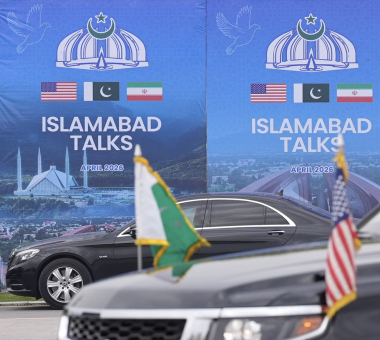
The first round of negotiations between the United States and Iran was held in the Pakistani capital, Islamabad, on April 11, 2026, lasting nearly 21 hours. The talks yielded no tangible results, except that they marked the first time since the Islamic Revolution in Iran that a U.S. official of the stature of the Vice President met with Iranian officials. Each side blamed the other for the failure of the negotiations.
In the second week of the truce between Iran and the United States, and amid Washington’s blockade of the Strait of Hormuz as a pressure tactic to compel Tehran to accept its terms, a ten-day truce between Israel and Lebanon was announced. This was followed by an announcement that the strait would be opened for one day, only to be closed again, reflecting the overall ambiguity of the situation.
Core Issues in the Islamabad Negotiations
The negotiations between Iran and the United States—whether conducted through mediators (Turkey, Egypt, and Pakistan) or directly in Islamabad—have faced several disagreements. The differences are not limited to perspectives on the issues themselves, but also in the inputs and outcomes related to the essence of the negotiations and the mechanisms for a ceasefire. While ten points were presented as a proposed ceiling for the demands to be negotiated, the United States announced fifteen points as its conditions for ending the war against Tehran, which began on February 28, 2026. The main points of contention can be outlined as follows:
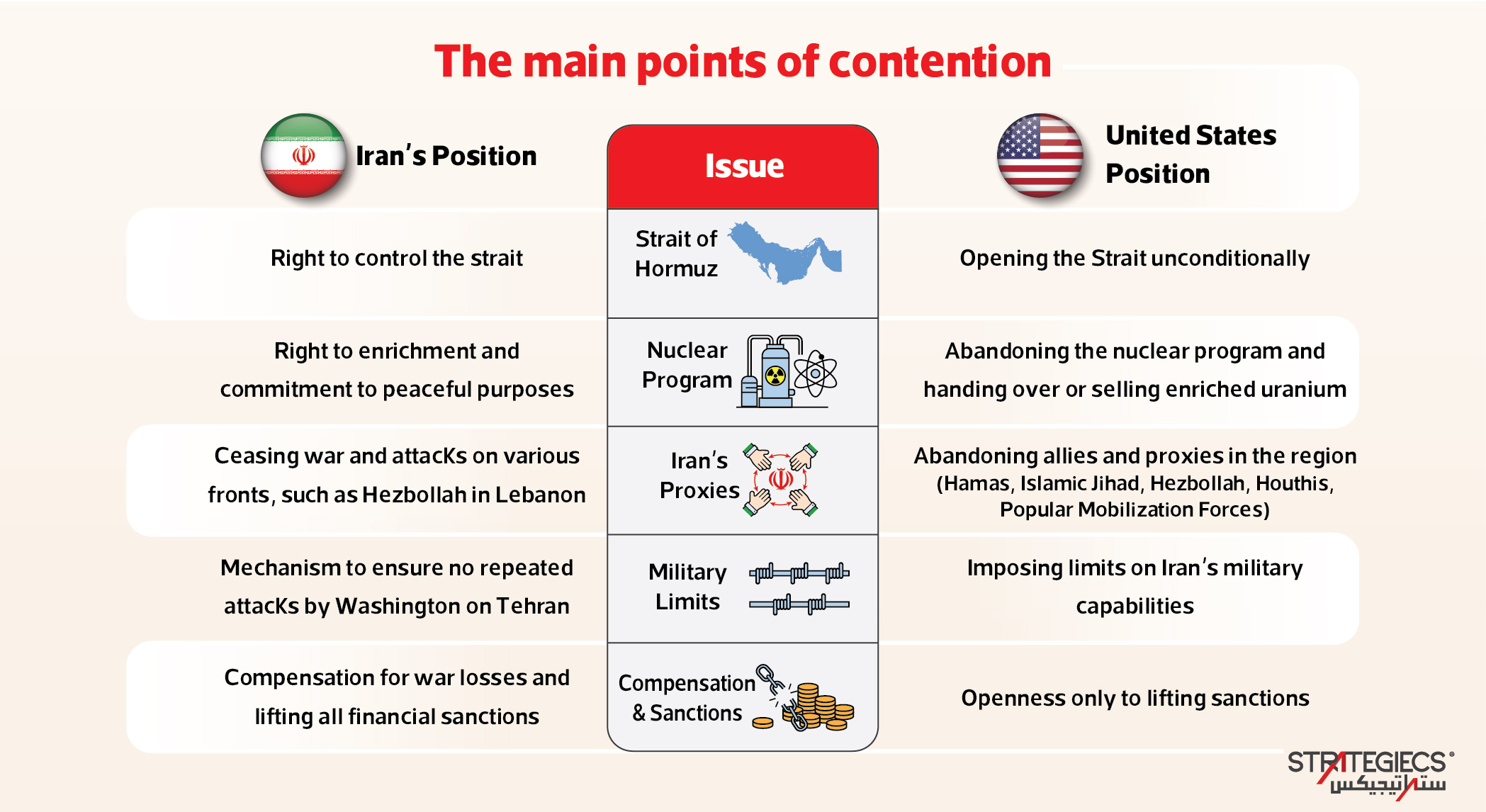
Based on these prior differences, which preceded the negotiation round in Pakistan, the meeting between the American and Iranian negotiating teams did not yield tangible results that could be clearly relied upon during the remaining days of the truce. This is due to several reasons.
First, the previous agreement between Iran and the United States— what is known as the (5+1)—lasted for nearly two years, having been concluded under the administration of former U.S. President Barack Obama, who adopted a less hardline approach than that of the first and second, non-consecutive Trump administrations,, which chose to withdraw from the agreement in 2018.
Second, the current points of contention require sufficient time to reach consensus formulas and for both sides to make concessions. These include issues such as the ballistic missile program and the halt or suspension of uranium enrichment for a specified period. While Iran has recently proposed suspending the program for five years, U.S. President Donald Trump favors extending the duration to approximately twenty years.
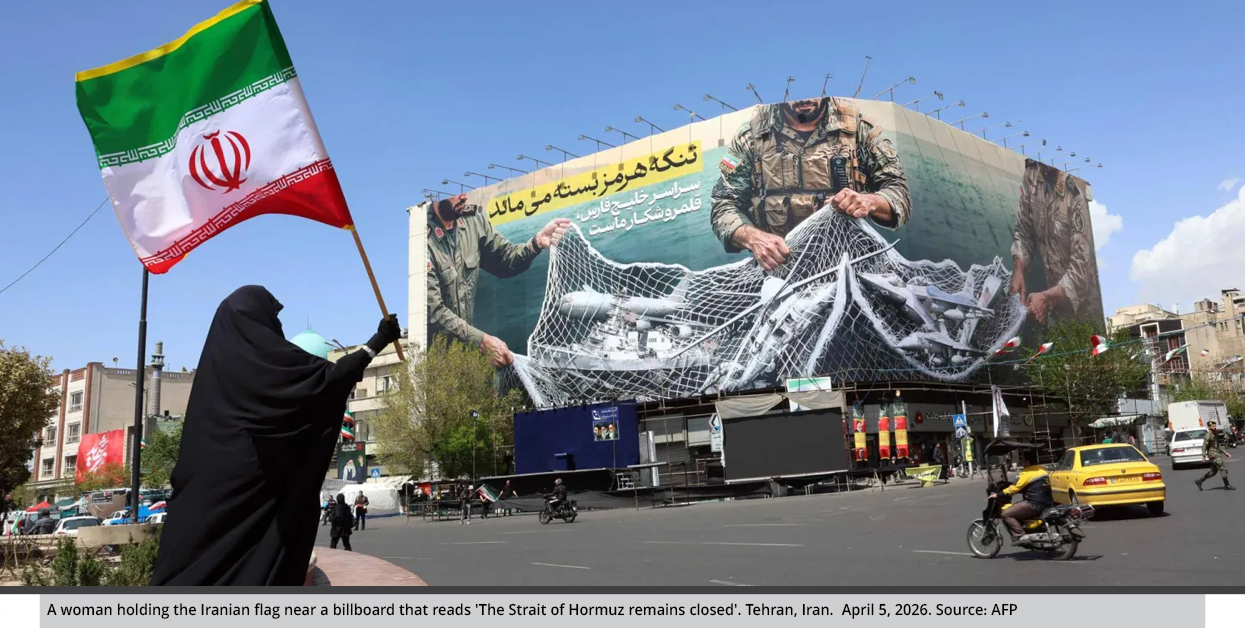
In reality, several indicators suggest that the three parties to the war are inclined toward a “timeout” from the conflict through negotiations, albeit to varying degrees. For Iran, the war poses existential risks to its political system, its future, and its ability to maintain control and sovereignty over its vast territory. The challenges it faces are no longer primarily about its external combat capabilities, but rather to its ability to ensure internal security and stability, as well as its flexibility in maintaining a balance among state institutions. This is especially important in light of the clear contradictions in statements by Iranian officials regarding whether the Strait should be opened. This was evident in the confirmations by Foreign Minister Abbas Araghchi and Parliament Speaker Mohammad Bagher Ghalibaf, who announced the reopening of the strait. However, the Islamic Revolutionary Guard Corps (IRGC)— which holds the greatest influence in this equation—later asserted that the strait remained closed.
On the other hand, Iran’s military trajectory since the outbreak of the war appears primarily aimed at returning to negotiations. It has shifted from deterrence against Israel to deterrence against the United States, through targeting oil fields in Arab countries and negatively impacting global markets, alongside engaging in economic terrorism in the Strait of Hormuz. This has significantly heightened global concerns and contributed to sustained increases in oil and shipping prices.
In contrast, Trump has often downplayed the importance of the Strait of Hormuz as an Iranian pressure tool. He had previously called on countries that rely partially on imports passing through the strait to form a defensive coalition to protect freedom of navigation there. His statements on March 26, 2026 , clearly indicated that the United States does not depend on the strait and is self-sufficient in energy production. Through this rhetoric, he also seeks to minimize the impact of Iranian actions in the Strait on energy prices within the United States. Moreover, the United States has effectively reversed the use of the Strait as a pressure tool against Iran, announcing on April 14 the beginning of a naval blockade against Iran.
For the United States, this war is clearly not comparable to the military operation in which U.S. forces captured former Venezuelan President Nicolás Maduro and compelled his regime to shift its approach and align more closely with American interests. In the current case, both the United States and Israel neutralized the Iranian leadership during the first hours of launching military operations , including the former Supreme Leader Ali Khamenei and the country’s military command structure. However, this was not sufficient to force the regime into surrender.
Even as strikes against Iran intensified and significant damage was inflicted on its missile, naval, and security infrastructure, the country has continued to demonstrate a relative degree of cohesion within its governing structure.
Moreover, Iran has demonstrated an ability to respond and cause extensive disruption across the region at relatively low cost. It has shifted from managing the war with a state mindset to a militia mindset. Its strikes and attacks have affected Arab states that are allies, intermediaries, or even neutral actors, and in some cases with greater intensity than those directed at Israel.
This approach is primarily driven by Tehran’s intent to increase the cost of war for the United States in particular, especially in light of the depletion of its stockpiles of long-range weapons, which have been subjected to continuous strikes since June 2025.
Nevertheless, it does not appear that the U.S. administration is facing any pressing pressure to halt the war at the current stage. The U.S. president has, on several occasions, indicated that the military operations are ahead of their planned schedule.
The statements issued by Trump, Secretary of Defense Pete Hegseth, Secretary of State Marco Rubio, and Vice President J. D. Vance, coinciding with the first round of negotiations, reflect a sense of operational easedespite the costs and consequences associated with the war.
According to them, Iran’s nuclear project has been destroyed, its missile capabilities have been significantly undermined, and its regional proxies are being targeted. This rhetoric, which preceded the negotiations, may suggest that the outcomes of the talks are of relatively low importance, as achieving objectives on the ground is viewed as faster than reaching them through an agreement. Alternatively, it may be part of a strategy to intensify pressure on Iran in order to extract concessions regarding the 15 demands.
This is particularly relevant given that several issues still require negotiation or potentially deeper military operations extending from air to ground. This is especially true regarding control over Iran’s stockpile of highly enriched uranium, as well as its underground missile cities that remain undiscovered or are located deep within mountainous terrain, making their complete destruction extremely difficult.
As for Israel, which views the war from a strategic perspective as a historic opportunity to overthrow the regime or neutralize its threats, its ability to achieve this through an air campaign remains questionable. At the same time, it is engaged in military operations of comparable complexity in Lebanon, where it has expanded its objectives by extending the security zone from roughly 5 kilometers to a much larger area stretching from south of the Litani River to the border.
Moreover, the ongoing war over the past three years has taken a toll on its economy. The Bank of Israel estimates that the economic losses from the wars in Gaza and Lebanon in 2024 and 2025 have reached approximately $57 billion, equivalent to 8.6% of GDP. With the continuation of the war in Iran, the impact on its domestic front is even broader in scope compared to the conflicts in Gaza and Lebanon.
Before the ceasefire agreement, Iran also reportedly introduced cluster warhead missiles, which are difficult to intercept and cause wide-area damage. According to the Israeli military, these missiles account for roughly half of the total missiles launched by Iran against Israeli cities since the outbreak of the war.
Blockade of the Strait of Hormuz: the practical reflection of “negotiations through strength”
The practical progression of the "Negotiation through Strength" principle— articulated by U.S. President Donald Trump on several occasions and adopted as a political doctrine during his second term—can be clearly traced. The first negotiation framework emerged following a series of losses suffered by Iran’s regional proxies, which had previously constituted one of Tehran’s most important bargaining chips.
After Washington assessed that Tehran was not yet willing to make the required concessions, it launched Operation “Midnight Hammer” in June 2025. This was followed by a second negotiation framework, which also failed to achieve its intended objectives, leading to the outbreak of the ongoing war.
It can also be observed that Washington does not base its decisions on the progress of the negotiations themselves, but rather on its assessment of Iran’s readiness to make concessions. From the perspective of the U.S. administration, the negotiation process is essentially a one-way track in which the American delegation presents its demands and awaits either Iranian acceptance or refusal. In the event of refusal, Washington moves toward escalating the use of force. For instance, it launched military strikes on February 28, just one day after a negotiation round that had been described as “promising.”
In contrast, Iran insists on a two-way negotiation process, one that leads to compromise solutions situated between the demands and conditions of both parties. In doing so, it draws on the experience of the 2015 nuclear agreement.
conversely, the United States seeks to impose a set of obligations on Iran and its political system. These include abandoning its nuclear program, restricting its missile development, and committing to non-aggressive or hybrid regional policies, as well as committing before the international community to ensuring freedom of navigation in the Strait of Hormuz.
On another level, it also places expectations on the Iranian public which recent developments and ongoing military operations have prepared with a conducive environment to demand greater freedoms and potentially even pursue regime change. However, such an outcome would not result from direct U.S. intervention or commitment.
In reality, the current U.S. administration stands out for employing an additional matrix of objectives and tools to intensify pressure on Iran. It was initially expected that the American blockade of Iranian freedom of navigation in the Strait of Hormuz would help expand and deepen concessions, including the reopening of the strait. However, Iran’s decision to close the strait again prompted the United States to adda new dimension to the blockade.
On April 20, the U.S. military announced an expansion of the maritime blockade imposed on Iran, transforming it from a localized cordon around Iranian ports into a global naval pursuit targeting any vessel linked to Tehran anywhere in the world.
In the cases of both Iran and, previously, Venezuela, the U.S. position regarding the continued and expanded blockade of the Strait of Hormuz can be understood through several factors.
First, it aims to further tighten the economic noose around Iran and to reject Tehran’s gesture of reopen the strait as a positive step toward negotiations.
Second, control over oil resources in both countries has emerged as a feasible objective, having already been implemented in Venezuela, and the U.S. administration may seek to replicate it in Iran—either by force through the continuation of the blockade, or through plans to control Kharg Island, or through negotiations, particularly given that Iran’s Deputy Foreign Minister for Economic Affairs, Hamid Reza Ghanbari, reportedly revealed an Iranian proposal prior to the war in mid-February 2026 indicating the possibility of granting U.S. energy companies special concessions in Iran’s energy sector.
However, the blockade of the Strait of Hormuz by U.S. forces raises several questions, including the following:
1- There are conflicting reports regarding the effectiveness of the U.S. blockade, in addition to the risks of potential clashes with the IRGC, which continues to target commercial shipping vessels, most recently occurred on April 22, 2026, when Iran reportedly attacked two vessels north of the Omani coast. This is further compounded by the presence of mines laid by Iran to control and restrict movement through the strait.
Although the blockade entered into force on Monday, April 13, data from Vortexa reveals that 34 oil tankers linked to Iran have successfully transited the Strait of Hormuz, effectively breaching the blockade. Among them was the tanker Alicia, owned by a Chinese company and subject to U.S. sanctions.
In light of the contradictory statements issued by both the American and Iranian sides, an additional question arises regarding the limits of the Trump administration willingness to confront Russia should Russian vessels attempt to transit toward Iranian ports?
2- If the main objective of the blockade on the Strait of Hormuz, as well as Iranian ports and coastal areas, is first to affect Iran’s oil revenues and thereby intensify economic pressure, and second to tighten the squeeze on China—given that China imports around 90% of Iranian oil, equivalent to about 11% of its total oil demand. Iran, in contrast, has developed extensive experience in circumventing Western sanctions on oil sales over the years, from 2018 up to the current war.
Moreover, the war itself has contributed to higher global energy prices, allowing Tehran to benefit from price differentials, with oil rising from roughly $75–80 per barrel before the war to over $100 during the conflict. Taking into account daily sales of around 1.5 million barrels, along with discounted pricing arrangements for China, Iran’s revenues may have exceeded $150 million per day. Naturally, the U.S. administration seeks to curb these increases in order to shift in Tehran’s position and push it toward accepting Trump’s demands in the negotiations.
Scenarios of the Islamabad Negotiation Framework
The ceasefire agreed upon between Iran and the United States ended on April 22. It was subsequently extended at Pakistan’s request, in light of the possibility of holding a second round of negotiations in Islamabad. During the period from April 8 to April 20, the United States activated both military blockade and economic pressure tracks against Iran, particularly through the imposition of economic sanctions on certain figures within the IRGC under what is referred to as the “Economic Fury” policy.
This policy is concerned with freezing the assets of individuals involved in Iranian oil smuggling networks, including the son of Ali Shamkhani. This step is viewed as having contributed to increasing pressure on Tehran to reopen the Strait of Hormuz, at least from the Omani side.
In light of the current developments and potential shifts within both the U.S. administration and Iran, several scenarios emerge, which can be summarized as follows:
First Scenario: Negotiation Failure and Return to War
The likelihood of the second round of negotiations stalling remains both possible and likely,, given that it is taking place alongside the continuation of the blockade and Washington’s ongoing intensification of its defensive and offensive military assets in the region. This aligns with the principle of “negotiating through strength,” which has been reflected in previous experiences, from the first negotiation framework to the second.
From the Iranian perspective, there is a prevailing assessment that the second round of the Islamabad talks may amount to little more than a tactical delay pending the completion of U.S. military reinforcements. Additionally, the timing of Washington’s renewed interest in negotiations is seen as coinciding with earlier attempts to stabilize oil markets and reduce prices, which ultimately proved unsuccessful. This has pushed the U.S. toward negotiations as a temporary option aimed primarily at achieving stability in oil prices.
The simultaneous occurrence of negotiations and warfare may represent a sustained pattern in which both parties enter a diplomatic framework while continuing to exchange military strikes, thereby managing the negotiation process through developments on the ground.
For the United States, ensuring the presence of negotiators capable of engaging and later implementing any agreement enhances its ability to continue the war until a decisive moment is reached—one in which Iran’s hardline current may be forced into retreat or weakened under the sustained pressure of the war. This is further reinforced by the low likelihood of Tehran making concessions on key files such as its missile program.
In this context, U.S. Special Envoy for the Middle East Steve Witkoff stated on March 26, 2026, that the Iranians “would not give up diplomatically what the U.S. could not win militarily,” suggesting that the dual-track approach of military action and diplomacy will remain tightly intertwined.
On the other hand, Iran’s maintenance of communication channels with Washington enables it to manage the momentum of the conflict without reaching a point of regime collapse or widespread internal chaos—an outcome that neither the United States nor regional actors desire.
If this scenario materializes, the United States appears to seriously threaten to continue the war. The U.S. president stated on February 26, 2026, that Iran faces two options: either conclude an agreement or face a sustained American military campaign. This could potentially involve an escalation in the intensity of military operations, including decisive strikes against the Iranian regime.
Such actions may include a broader operation to assert control over the Strait of Hormuz, as well as the use of special forces and ground operations to secure Iran’s stockpile of highly enriched uranium. They could also extend to targeted assassinations of emerging second-generation leaders, including Supreme Leader Mojtaba Khamenei and the newly appointed Secretary of the Supreme National Security Council, Mohammad Bagher Zolghadr.
Second Scenario: Successful Negotiations and an End to the War
The success of the negotiations depends on the ability of both the United States and Iran to build mutual confidence in the negotiation framework. Several indicators support the possibility of this scenario, including the growing time pressure on the U.S. administration, which is constraining its ability to continue pursuing the option of war.
Additionally, changes in the negotiating teams suggest a renewed attempt to give new figures a chance to engage more effectively than in previous rounds. On the U.S. side, Vance has taken on a direct leadership role in the negotiations, replacing Witkoff and Jared Kushner. On the Iranian side, the participation of Parliament Speaker Mohammad Bagher Ghalibaf as head of the negotiating team is seen as a direct endorsement from the Supreme Leader, given Ghalibaf’s influence within the leadership’s inner circles.
At the same time, the negotiations provide Iran’s new leadership with an opportunity to demonstrate both domestic and international effectiveness, potentially pursuing a different approach from the previous generation. The United States likely entered these negotiations based on such assessments. If successful, the talks could offer the Iranian regime a margin to claim victory in the war, as its primary objective has shifted toward survival rather than preserving the instruments of power that have been significantly weakened during the conflict.
There is also a possibility that second-generation Iranian leaders are aware of the risks of targeted assassinations, which could weaken the system, disrupt its chain of command, and plunge the country into instability and a leadership vacuum.
Third Scenario: A state of uncertainty between war and no war
This scenario is considered the most dangerous for the region and could materialize if the war deepens and the ability to communicate or negotiate with the Iranian side is lost. This may occur either as a result of the failure of the current negotiations and Iran’s complete loss of trust in the diplomatic process, or due to a broader wave of assassinations that leaves third- and fourth-tier Iranian leaders in control of the country, without a balance of power among them or the ability to make decisions at the national level. In such a case, the war would likely persist in an intermittent manner, characterized by disruptive attacks from the Iranian side, in contrast to surgical operations and intelligence campaigns conducted by the United States and Israel.
Fourth Scenario: Intensifying Alternative Pressure
The United States may substitute direct military operations against Iran with an intensified pressure strategy. This has already begun with banning vessels linked to Iran from transiting the Strait of Hormuz in both directions and expanding these restrictions to target Iranian-linked shipping globally.
Such measures could extend to additional tools of pressure, including the declaration of no-fly zones over Iran—potentially covering both civilian and military aviation—as well as the imposition of sanctions on countries that engage with Iran through transit routes and overland shipping. The objective would be to transform the maritime blockade into a comprehensive siege encompassing air and land domains.
STRATEGIECS Team
Policy Analysis Team