 العربية

Post-Organization State: Transformations in Terrorism, Organized Crime, and Intelligence When the Armed Actor Transitions to Sovereign Power
This theoretical framework serves as an introduction to a forthcoming book, which argues for the development of a new analytical and conceptual layer within the fields of terrorism studies and intelligence theory. This is necessary to keep pace with structural shifts in the nature of armed actors—specifically, their transition from merely managing armed organizations to seizing sovereign authority and exercising state functions. The framework aims to construct a practical approach for identifying this transformation and detecting its early indicators. It further proposes a model for how states might craft diplomatic and security responses to such actors—responses tailored to the evolution in their status, functions, and instruments of influence. The objective is to enable states to continue pursuing their national interests and managing relations with these authorities, while simultaneously maintaining constant security and intelligence vigilance regarding their activities and ongoing transformations.
by Hazem S. AL-Dmour
- Release Date – Nov 12, 2026

Executive Summary
Counterterrorism studies face a complex analytical challenge when an armed group with an extremist or terrorist history transitions from the position of a “non-state actor” to that of a governing authority. The concepts designed to understand clandestine cells, financing and recruitment networks, and irregular violence are insufficient on their own to analyze an authority that possesses ministries, borders, budgets, security agencies, and diplomatic interactions. This transition does not necessarily mean the continuation of terrorist behavior, just as political recognition does not establish that genuine institutional transformation has taken place.
This paper proposes an integrative framework known as the “Armed Actor-to-Sovereign Transition Framework,” which incorporates the literature on the transition from insurgency to governance, rebel governance, network continuity, state-building, institutional capture, and political violence studies. This framework establishes the distinction between a change in an actor’s legal status and a change in its decision-making structure, means of exercising violence, and relationship with society and the state.
The primary methodological finding is the need to move from classifying actors based on their past and rhetoric to a gradual assessment of actual behavior, chains of command, institutional control, cross-border relations, and accountability, while distinguishing between hypotheses, observations, and substantiated evidence. Accordingly, there is a set of questions and variables that must be taken into consideration:
The Problematic of New Counterterrorism Studies
Many security models have been based on a structural distinction between the state as the holder of legal authority and armed organizations as non-state actors that challenge its monopoly on the use of force. This distinction has helped in studying recruitment, violent extremism, financing, clandestine leadership, targeting, and the relations of transnational groups. However, some conflict trajectories produce situations in which the armed group itself becomes the center of state authority or a major party to it. In such cases, the sources of power, opportunities, and constraints change. Public resources become available for mobilization, while administrative, intelligence, and military capabilities expand. At the same time, obligations under international law, economic and service needs, and foreign relations emerge. However, the transfer of leadership to institutions does not necessarily eliminate old trust networks, the combat mentality, or practices of coercion. Therefore, the question is not whether a “former terrorist” can assume a political status, but how transformation or continuity in objectives, means, and institutions can be monitored in a verifiable manner.
First: Defining Concepts and the Limits of Description
1- Terrorism and state-attributed terrorism; the term itself, as a concept, is subject to legal and political disagreement, particularly when moving from describing an armed group to describing actions carried out by government agencies. Therefore, the research requires distinguishing between three variables:
- Terrorist acts committed by groups that are not affiliated with the state.
- State support for entities that commit terrorist acts.
- Grave or systematic violations committed by state agencies, which may legally fall under international crimes or human rights violations without automatically being accurately described as “state terrorism.” The elements of the act, intent, attribution, and legal responsibility remain essential to every characterization.
2- Organizational Identity versus Institutional Behavior
The previous backgrounds of leaders or their ideological affiliations are insufficient to infer their current behavior. Conversely, renaming agencies or issuing moderate rhetoric does not constitute conclusive evidence of a rupture with previous practices. Therefore, the paper uses three independent units of analysis: the individual leader, the organizational network, and the government institution. Each unit may change according to shifts in its trajectory, objectives, and external operators.

Second: The Integrated Theoretical Framework
1- The Transition from Insurgency to Governance
The literature on the transition of armed groups to political activity and governance examines the conditions for transforming a combat structure into civilian institutions, including the demobilization or integration of fighters, the distribution of authority, the removal of factional character from security, and the redefinition of legitimacy. This literature is useful in analyzing both institutional success and cases of incomplete or hybrid transformation.
2- Rebel Governance
Studies on rebel governance, most notably the works of “Zachariah Mampilly,” demonstrate that armed actors may develop systems of taxation, justice, education, and service provision before coming to power. Here, institution-building does not begin from scratch after victory; rather, old arrangements of control may be transferred to the state level or reshaped under the pressures of legitimacy, the economy, and society.
3- Network and Organizational Continuity
The works of University of Chicago political science professor and American researcher specializing in political violence and international security, “Paul Staniland,” on insurgent networks help explain the persistence of personal, military, and social ties after a change in political form. From a research perspective, it is necessary to measure who actually makes decisions, how appointments, resources, and sanctions are managed, and whether formal influence relies on legal rules or inherited networks of trust and loyalty.
4- State-Building and Organized Violence
Sociologist and historian “Charles Tilly” provides us with a historical approach to understanding the relationship between state-building, the monopoly on violence, taxation, and protection. However, the use of this approach is analytical rather than justificatory; the similarity between certain techniques of resource extraction or coercive monopolization does not establish legal equivalence between the state and organized crime, nor does it exempt authorities from their legal and human rights obligations. Until his death, Tilly “did not consider revolution a separate political phenomenon, but rather a manifestation of conflict power relations, and an extension of violent and nonviolent collective action policies—or the ways in which people work together in pursuit of common interests.”
5- State Capture and the Illicit Economy
The concepts of state capture and criminal governance make it possible to analyze cases in which public positions and contracts, customs, borders, and law enforcement agencies are harnessed to serve private or illicit networks. A distinction must be made between limited corruption within an institution, recurring collusion between officials and criminal networks, and structural control over decision-making mechanisms. Each level requires different evidence.
Third: The Proposed Model—The Armed Actor's Transition to Sovereign Authority
The model is based on a foundational assumption: control over the state changes the actor’s capabilities and incentive environment, but does not predetermine whether it will transform into an authority constrained by law or maintain organizational patterns. To avoid the misleading binary between “complete moderation” and “complete continuity,” the paper proposes three explanatory pathways that may overlap:
- The first pathway is “institutional transformation,” which relies on building accountable public agencies, unifying military command, reducing previous organizational ties, and protecting the population regardless of its loyalty to the transitional or new authority.
- The second pathway is “hybrid transformation,” which represents the coexistence of emerging formal institutions and factional or ideological networks of influence that persist in specific areas, with varying levels of discipline across sectors.
- The third pathway is “coercive continuity,” which represents the use of instruments of power to reproduce patterns of targeting, repression, or illicit support, based on attributable evidence rather than presumed intentions.
Fourth: The Multi-Level Monitoring Matrix
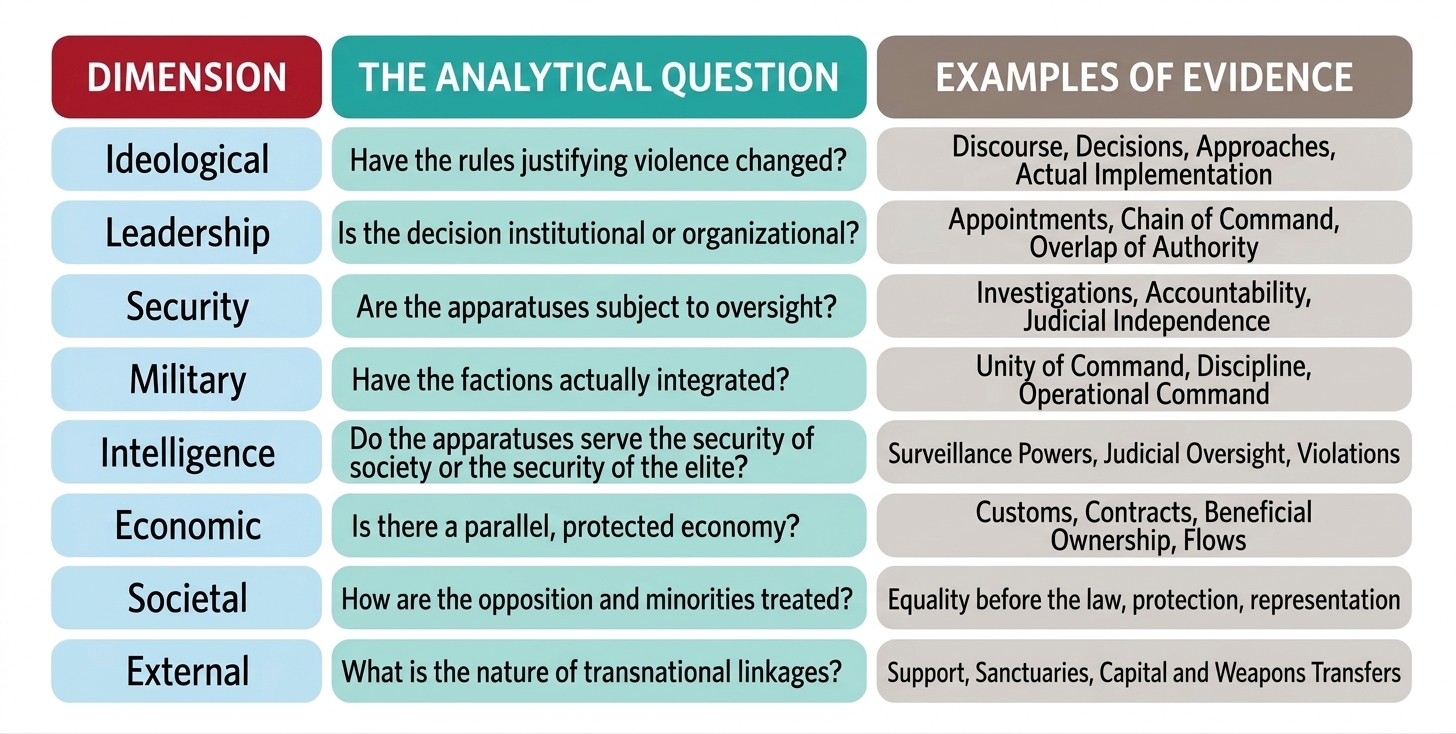
To initially establish the direction of the paper, given that this effort requires numerous theoretical and diagnostic frameworks, it is important for us to classify each piece of information according to its source and degree of independence, while distinguishing between official announcements, operational capacity, and field practices. Each case must also include potential disconfirming indicators, such as holding influential officials accountable, dismantling previous networks, or protecting opposition groups, so that the model does not become a tool for confirming a preconceived impression.
Fifth: Integrating Terrorism, Organized Crime, and Intelligence
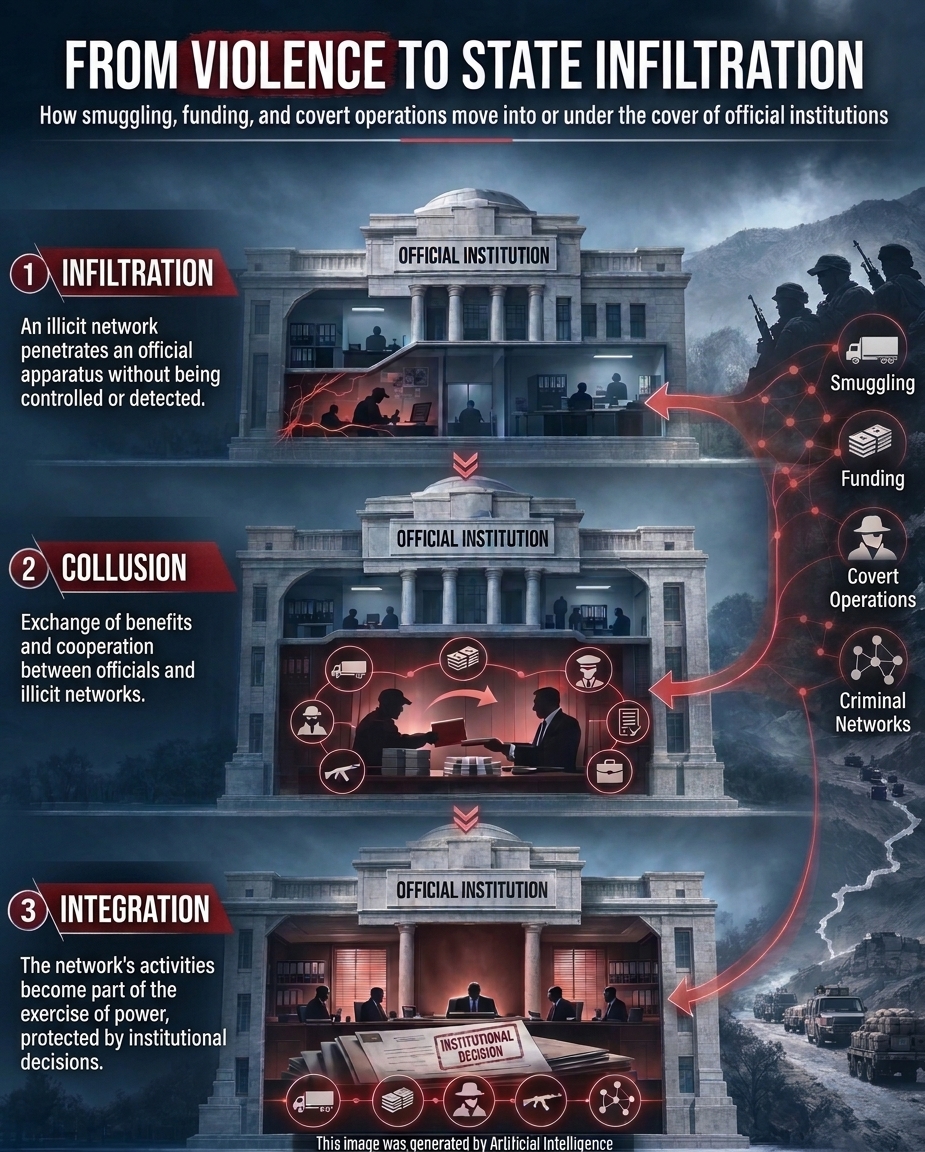
The security challenge lies not only in the possibility of the continued use of violence, but also in the possibility of transferring smuggling, financing, and covert operations networks into the structure of official institutions or operating under their cover. Therefore, it is necessary to distinguish between the forms of relationships monitored by security researchers and experts in the relationships between transitional officials or new leadership figures. Infiltration occurs when an illicit network penetrates an agency without controlling it, while collusion occurs when officials and illicit networks exchange benefits. Integration becomes evident when some or all of the network's activities become part of the exercise of power and are protected by an institutional decision.
In the intelligence domain, the issue lies in distinguishing between protecting national security and protecting the survival of the ruling group. This situation can be measured through legal oversight frameworks, the limits of monitoring political opponents, mechanisms for handling personal information, the attribution of responsibility for operations, and the nature of relations with external networks. The existence of a powerful or secret agency is insufficient to conclude that illicit behavior is taking place; rather, the determining factors are authorization, actions, oversight, and accountability.
Sixth: Research Tests for Assessing the Transition
There is a set of tests and behaviors that demonstrate the transformation of a transitional authority that previously operated within a terrorist organization and seized power. Several tests can therefore be included:
Behavioral Rupture Test: Are attacks against civilians condemned, prevented, and their perpetrators held accountable, even when they are close to the leadership?
Institutional Independence Test: Are judicial and oversight bodies able to hold security agencies and influential leaders accountable?
1- Political Cost Test: Is the ruling elite willing to dismantle its old networks when they conflict with the building of public institutions?
2- External Relations Test: Does financing, training, sheltering, or directing violent groups beyond borders continue? What is the nature of the evidence for official support?
3- Crisis Test: Does the pattern of governance change during protests, armed threats, and sectarian crises, and are the rules governing the use of force respected?
Seventh: Testable Hypotheses and Comparative Design
- First hypothesis: The persistence of unregulated loyalties tied to former originations within security agencies is associated with a higher likelihood of reproducing old practices, while taking into account the effects of ongoing war and weak government capabilities.
- Second hypothesis: Diplomatic integration and external recognition may contribute to supporting institutional transformation, but the effect depends on conditional incentives, accountability, and the ability to enforce the law. Therefore, no automatic relationship between recognition and moderation should be assumed.
- Third hypothesis: The longer informal financial and logistical networks persist after a group transition to governance, the greater the importance of political economy and organized crime in explaining decision-making, without this necessarily meaning that all these networks are illicit.
It is recommended to adopt a comparative design that includes cases with varying outcomes, including experiences that have witnessed relatively successful institutional transformations, while employing process tracing, network analysis, decision analysis, and cross-verification of testimonies and independent reports. Cases should be selected according to clear criteria, rather than ideological similarity alone.
Eighth: Methodological Limitations and Accuracy Safeguards
First, the historical classification of an organization or its leader cannot be turned into a permanent judgment on a subsequent government. Second, the inability of a government to control armed groups must not be confused with issuing orders to commit violations. Third, evidence of violations must be distinguished from evidence of political or institutional support. Fourth, institutions within the same state may change at varying speeds; therefore, unsupported blanket classifications should be avoided. Fifth, comparisons require specifying the time period, sources of evidence, degree of certainty, and alternative hypotheses.
Ninth: Toward a New Research Agenda
The current phase does not require replacing terrorism studies with a theory of the “terrorist” state, so much as it requires linking terrorism and organizational transformation studies with state-building, security governance, organized crime, and intelligence. Sovereignty does not establish a rupture with the past, nor does it establish the continuation of that past. What establishes or refutes transformation is the accumulation of reliable evidence regarding patterns of decision-making, violence, institutions, accountability, and the impact on the security of neighboring states.
Accordingly, a question can be formulated for this paper, which I propose as a future research agenda: Does an armed actor's acquisition of the instruments of sovereignty lead to the reshaping of its organizational logic under state constraints, or does it enable the actor to reproduce that logic on a broader institutional scale?
Answering this question requires structured comparison, not prior assumptions, and calls for tools that go beyond the traditional boundaries between counterterrorism and the study of the state, crime, and intelligence.

From Security Target to Sovereign Partner: The Strategic Dilemma for Neighboring States When Leaders of Armed Organizations Take Power in States!!
There is a need for an in-depth examination of shifts in the concept of threat, the limits of political recognition, the challenges of intelligence trust, and the future of regional security, through a set of security and political concepts. The question can be divided into a number of criteria to ultimately reach an objective conclusion.
First: The Dilemma Is Not the Former Fighter's Accession to Power, but Rather the Reversal of the Relationship Between the State and the Threat
This phenomenon presents an unconventional challenge to national security and counterterrorism studies, as some states find themselves facing a reality in which individuals who were once the subject of security pursuits, or affiliated with organizations designated as terrorist, become presidents, ministers, or heads of security agencies in neighboring states. These individuals are no longer merely persons who can be dealt with through wanted-person files and information exchange; rather, they become representatives of authorities that control territories, borders, and institutions, and exercise sovereign powers. It is the moment when the subject of previous intelligence work becomes an official party to diplomatic and security relations.
Perhaps the most serious challenge is that the institutions of neighboring states face a contradiction between their security memory and their current strategic calculations. Agencies that have accumulated information over the years about these individuals, their networks, ideologies, and sources of financing may find themselves required to cooperate with them in securing borders, combating terrorism, and exchanging intelligence. These agencies thus face the following question: How can a state establish a stable security relationship with a new authority without assuming that political transformation has eliminated the previous threat, and without allowing the past alone to serve as a final judgment on the present?
This is the essence of what can be termed the “Sovereign Recognition-Intelligence Memory Paradox,” an analytical concept I propose to describe this contradiction, rather than an established independent theory.
Second: How Is the National Security System of the Neighboring State Affected?
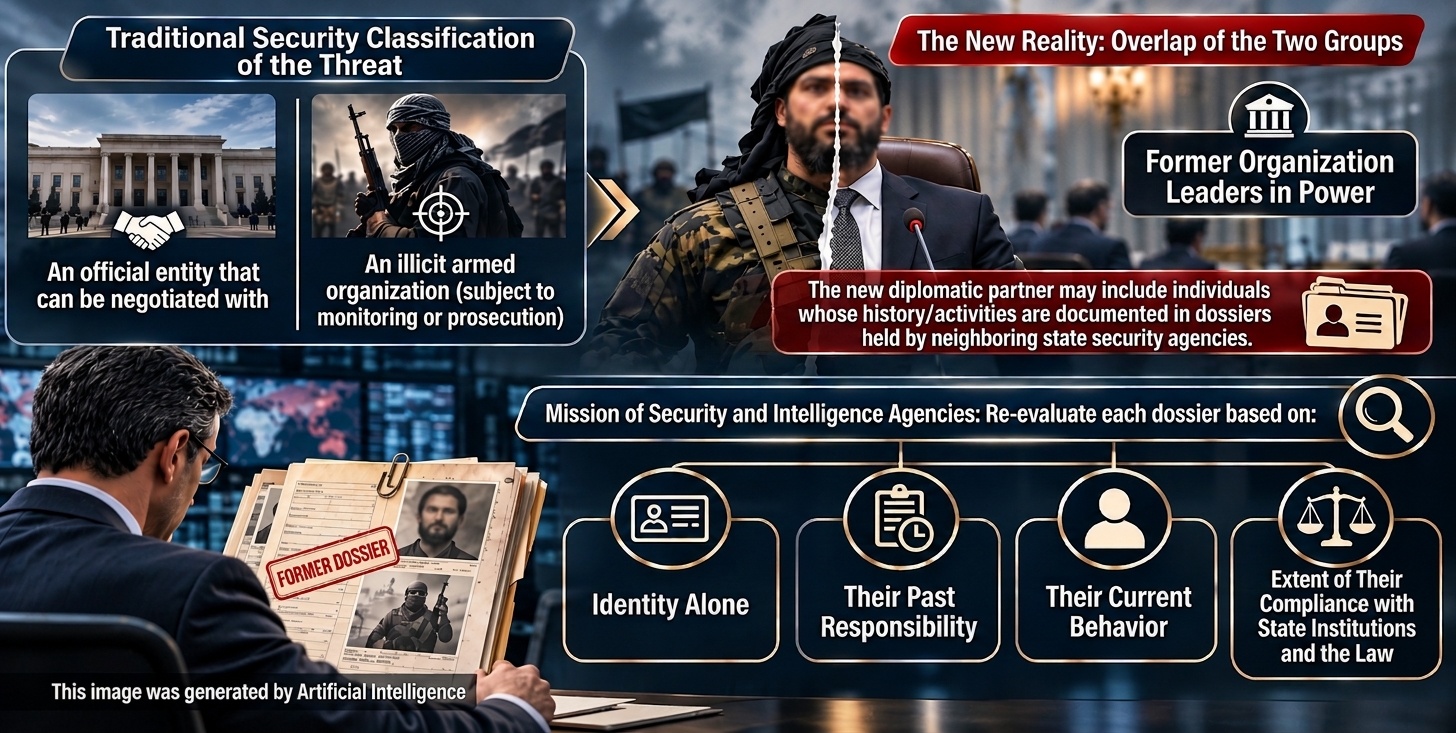
The impact does not stop at the possibility of fighters infiltrating across borders or weapons being smuggled across them; rather, it extends to reshaping the strategic perceptions underpinning security, defense, and intelligence policies. The traditional security classification of threats collapses, whereas the neighboring state previously distinguished, to some extent, between an official entity with which it could negotiate and an illicit armed organization subject to monitoring or pursuit. However, when the former organization's leaders come to power, these two categories overlap. The new diplomatic partner may include individuals about whom the neighboring state's agencies retain files concerning their previous armed activities. Security agencies must then reassess each file, not solely on the basis of the identity of the individual concerned, but also according to their previous responsibility, current behavior, and the extent to which they are subject to state institutions and the law.
1- The Potential Transfer of Organizational Networks into State Institutions
The situation becomes more sensitive if old loyalty networks persist within security and military agencies. The question is not whether the Minister of Defense or the Director of Intelligence is a former fighter, but whether the institution they manage has become a national agency subject to the law, or whether it still operates according to the logic of the former organization. From the perspective of neighboring states, the persistence of parallel structures may generate risks related to weak discipline, some individuals' tolerance of smuggling networks, or the existence of cross-border loyalties.
2- The Emergence of an Intelligence Trust Dilemma
Intelligence cooperation is based on trust, but it also relies on assessing the risks of exposing sources and methods. Here, practical questions arise: Can information about extremist networks be shared with a security agency that includes individuals who were previously connected to these networks? Will the information be used to combat terrorist activity, or could it leak to unauthorized parties? In my view, the professional solution is not to refrain entirely from cooperation, but rather to adopt gradual trust conditioned on verification, while restricting information sharing according to its sensitivity and purpose, and continuously reviewing the outcomes.
3- The Reshaping of Border Threats
When authority changes in a neighboring state, the entities controlling border crossings, border areas, and local economic networks change with it. This development may be positive if it leads to dismantling previous smuggling networks and unifying security agencies. However, it may be negative if new networks emerge that exploit weak oversight, political influence, or military divisions. Therefore, the accession of former fighters to power should not be taken as evidence of an increase in smuggling or terrorism, nor should it automatically be taken as evidence of a decline in either.
4- The Transfer of Extremism Risks from Organizations to the Political Environment
Risks may also emerge when extremist religious or ideological rhetoric is used to justify exclusion or political violence, or when former extremist figures become symbols, whose experiences are repurposed for mobilization purposes. However, a distinction must be made between the existence of an extremist ideological background and the existence of an official policy of incitement to terrorism, financing it, or facilitating it. This process is important and necessary in reassessment to prevent security studies from turning into hypothetical judgments about intentions and past records.
Third: How Do Neighboring States Accept These Leaders?
States do not necessarily need to trust a ruler personally in order to establish official relations with the state he governs. Geography and security interests may make cooperation necessary, even between parties, each of which has a long history of mistrust toward the other. This transformation can be understood through the following levels, whereby states accept this reality through what may be described as “Conditional Functional Normalization”; that is, engaging with the new authority to the extent that serves stability and interests, while continuing the security and legal assessment of its institutions and leadership.
Accordingly, a head of state may receive a leader whose name was listed on terrorism lists, while the relevant agencies continue monitoring the threats associated with his former networks. There is not necessarily any institutional contradiction in this; diplomacy and security perform complementary but distinct functions. Perhaps the principle of “geography comes before trust” is what governs these matters, because the traditional doctrine of counterterrorism focuses on identifying organizations, dismantling their networks, preventing their financing, and pursuing wanted individuals. However, when members of an armed organization transition into positions of power, a new task emerges: assessing the ability of the authority itself to serve as a reliable partner in counterterrorism. This requires a shift from classification-based security to behavior- and verification-based security, through the following:
1- Diplomatic Containment: Opening official channels to address border and political issues without assuming that established security trust exists.
2- Limited Security Cooperation: Exchanging specific information on shared threats within legal frameworks and procedures to protect sources and data.
3- Building Trust Through Performance: Measuring the authority's commitment to its pledges, its response to threats, its prevention of violations, and the extent to which its agencies are subject to oversight.
4- Institutional Security Partnership: Expanding cooperation if the sustainability of institutional performance is demonstrated and the risks of leaks, collusion, and abuses can be controlled, although I am not inclined toward this at all and expect it to remain within the narrowest limits.
A highly sensitive issue arises here: Does a state remove former figures from security assessment lists as soon as they acquire sovereign status? From my perspective as a researcher and observer, there is no single answer that applies to all legal systems. Removing a name from an international sanctions list does not automatically cancel any independent national criminal prosecution, nor does the continuation of a previous prosecution mean that the official is legally convicted. This requires coordination among three files: judicial prosecution, designation and sanctions, and intelligence risk assessment. Each has its own rules, justifications, and review procedures.
But the important question we arrive at is: What if the new state fails to undergo institutional transformation? In the case we are studying, there is a simple desire to halt the activities of certain networks, but the state lacks the actual capacity to do so. In this case, the source of the threat is the state's weakness, not its deliberate policy. Distinguishing between incapacity, complicity, and official direction is an essential condition for any sound intelligence assessment. This ultimately brings us to the most dangerous question concerning neighboring states: Do states import the threat, or does the new authority export it? This brings us to a new concept: “Sovereign Legitimacy Risk Transmission.” This is merely an analytical proposal for assessing whether the new authority's capacity to engage in diplomatic, economic, and security activities creates new opportunities for illicit networks or, conversely, helps dismantle them.
To be tested through four practices:
- Do former armed networks benefit from official institutions to move across borders or obtain resources?
- Does the new leadership have the will and capacity to prevent its territory from being used to threaten neighboring states?
- Does it maintain relations with cross-border extremist actors, and what is the nature of these relations?
- Do the policies of security agencies actually change when former organizational interests conflict with the interests of the current state?
The most important recommendation for national security studies is to consider the security of neighboring states in following the rise of armed organizations to power, from intelligence memory to conditional sovereign recognition. This is linked to four hypotheses:
- First Hypothesis: The more the institutions of the new state rely on former armed loyalty networks, the more difficult it becomes to build sustainable security trust with neighboring states.
- Second Hypothesis: When border, economic, and security interests are interconnected, diplomatic relations may expand faster than levels of intelligence trust.
- Third Hypothesis: Conditional security cooperation can contribute to advancing institutional transformation, provided that it is linked to verifiable performance and accountability standards.
- Fourth Hypothesis: The new leadership's limited ability to control factions and armed networks becomes a cross-border threat, even when that leadership does not adopt a hostile policy toward its neighbors.
Executive Summary
The rise to power of figures previously associated with extremist or terrorist organizations does not merely raise the question of whether neighboring states personally accept these leaders. Rather, it compels them to reconsider the relationship between political legitimacy, security trust, legal responsibility, and geopolitical interests.
The real challenge lies in the fact that a neighboring state cannot ignore the authority governing its borders, but neither can it base its security doctrine on the assumption that assuming power has fundamentally and permanently transformed the nature of all those who now hold positions of authority.
A state may recognize a government, cooperate with its security agencies, and engage with its president in accordance with diplomatic norms, while simultaneously maintaining an independent assessment of the security risks associated with its institutions, networks, and cross-border relations.
Therefore, the transformation that warrants examination is not merely the transition of armed groups into governance, but also the shift in neighboring states' approach from combating these groups to managing security relations with authorities led by some of their former members.

Hazem S. AL-Dmour
General Manager / Specialized Researcher in International Relations and Strategic Studies